Artificial Intelligence has become an essential part of modern digital marketing. Businesses, agencies, freelancers, and content creators are increasingly using AI tools to generate blogs, social media posts, advertisements, email campaigns, product descriptions, and website copy. These tools have significantly reduced the time required to produce content, allowing marketers to work more efficiently.
Despite these advantages, a large percentage of AI-generated marketing content fails to achieve meaningful business results. Many AI-written articles receive little organic traffic, struggle to rank on search engines, generate low engagement, and fail to convert visitors into customers.
The primary reason is not the technology itself but the way it is used. AI is capable of generating text quickly, but it cannot independently replace strategic thinking, audience research, business experience, or marketing expertise. Professional marketers understand that AI is most effective when it supports human decision-making rather than replacing it.
This article explains the key reasons why AI-generated marketing content often underperforms and describes the methods professionals use to create high-quality content that performs well in search engines and supports business growth.
The Growing Role of Artificial Intelligence in Marketing
Artificial Intelligence has transformed content creation by automating tasks that previously required significant time and effort. Modern AI tools can assist marketers in creating various forms of digital content, including:
- Blog articles
- Website copy
- Social media content
- Email marketing campaigns
- Advertisement copy
- Product descriptions
- Video scripts
- Landing page content
The main advantage of AI lies in its speed and efficiency. However, producing content quickly does not necessarily result in high-quality or effective marketing material. Search engines and users evaluate content based on its usefulness, relevance, originality, and ability to solve specific problems.
Therefore, speed alone cannot guarantee better search rankings or higher conversion rates.
Understanding Why AI-Generated Marketing Content Fails
The majority of AI-generated marketing content fails because it focuses primarily on generating text rather than delivering meaningful value to the intended audience.
Successful marketing content is built on several important elements, including audience research, business objectives, search intent, brand positioning, customer psychology, and practical experience. AI cannot independently understand these aspects unless they are clearly defined by the user.
When AI receives limited instructions, it typically produces generic information that resembles thousands of similar articles available online. Such content offers little originality and provides limited value to readers, making it difficult to compete in search engine rankings.
Major Reasons AI-Generated Marketing Content Performs Poorly
a) Lack of Originality: One of the most common weaknesses of AI-generated content is the absence of original insights. Since many users provide similar prompts, AI often produces comparable responses for different websites.
As a result, many published articles contain nearly identical information, making it difficult for search engines to identify unique value.
Original content generally includes:
- Practical observations
- Industry knowledge
- Personal experience
- Unique examples
- Business-specific insights
These elements cannot be generated automatically without human contribution.
b) Limited Understanding of Customer Behaviour: Effective marketing depends on understanding customers rather than simply producing written content.
Professional marketers study customer behaviour by analysing:
- Pain points
- Buying motivations
- Customer expectations
- Frequently asked questions
- Decision-making processes
Artificial Intelligence does not possess genuine knowledge of customer emotions or purchasing behaviour. It relies entirely on the information provided through prompts.
Consequently, AI-generated content often explains a topic but fails to address the actual concerns of potential customers.
c) Absence of Practical Experience: Experience is one of the strongest indicators of content quality.
Readers tend to trust articles that demonstrate practical knowledge gained through real projects, campaigns, or business situations.
Professional content frequently includes:
- Case studies
- Campaign results
- Industry observations
- Practical recommendations
- Lessons learned from experience
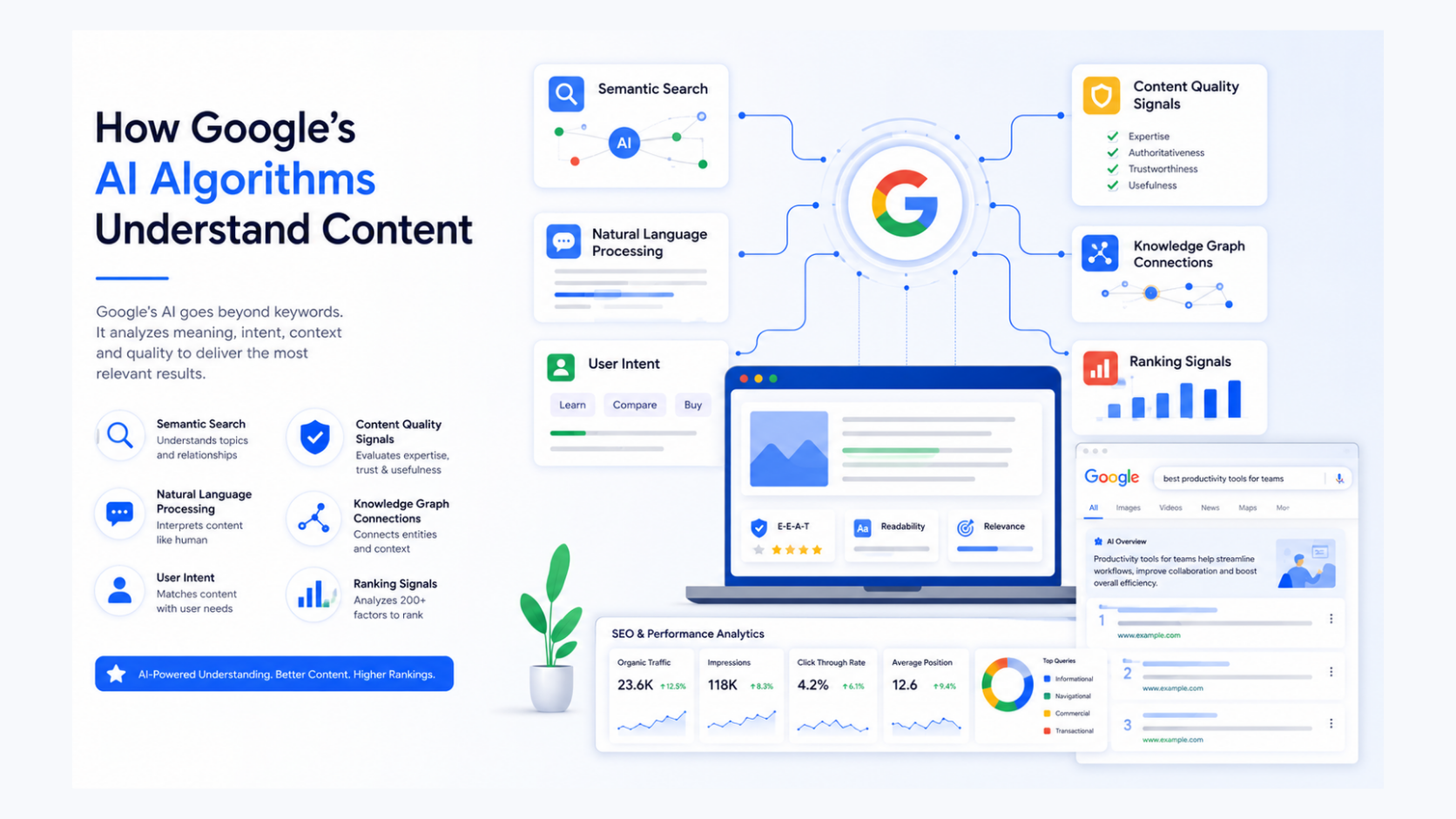
These components strengthen credibility and support Google’s Experience, Expertise, Authoritativeness, and Trustworthiness (EEAT) principles.
d) Poor Search Intent Optimisation: Search intent refers to the reason behind a user’s search query.
Every keyword reflects a specific objective. Some users seek information, while others compare products or intend to make a purchase.
Professional marketers classify search intent into four primary categories:
Search Intent | Purpose |
Informational | Learn about a topic |
Navigational | Find a specific website or brand |
Commercial | Compare available options |
Transactional | Complete a purchase or enquiry |
AI-generated content frequently overlooks these distinctions, resulting in articles that fail to satisfy user expectations.
e) Weak Content Structure: Content structure directly influences readability and user experience.
Well-organised articles are easier to read and understand because they divide information into logical sections.
A professionally structured article generally includes:
- Clear headings
- Short paragraphs
- Bullet points
- Numbered lists
- Tables
- Frequently Asked Questions
- Logical progression of ideas
Poorly structured content increases bounce rates and reduces reader engagement.
f) Inconsistent Brand Voice: Every organisation communicates differently depending on its industry, audience, and brand identity.
For example:
- Educational institutions focus on clarity and trust.
- Luxury brands emphasise exclusivity.
- Technology companies prioritise innovation.
- Healthcare providers maintain professionalism and accuracy.
AI cannot consistently reproduce a unique brand voice without detailed guidance and human editing.
g) Lack of Fact Verification: Although AI can generate informative content, it may occasionally produce outdated, incomplete, or inaccurate information.
Professional marketers verify:
- Statistics
- Industry trends
- Technical details
- Legal information
- Product specifications
Fact-checking protects credibility and ensures the published content remains reliable.
Comparison Between AI-Generated Content and Professionally Developed Content
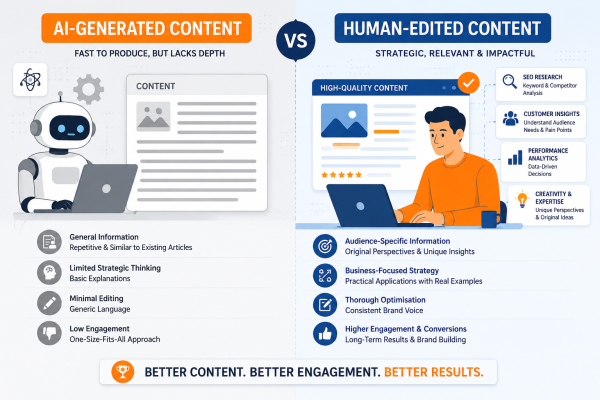
AI-Generated Content | Professional Marketing Content |
General information | Audience-specific information |
Similar to existing articles | Original perspectives and unique insights |
Limited strategic thinking | Business-focused content strategy |
Basic explanations | Practical applications with real-world examples |
Minimal editing | Thorough editing, optimisation, and fact-checking |
Generic language and tone | Consistent brand voice and messaging |
Low engagement and weak storytelling | Higher reader engagement with compelling storytelling |
Keyword stuffing or random SEO | Strategic SEO aligned with user intent |
Lacks clear conversion goals | Designed to generate leads, sales, or enquiries |
Generic calls-to-action | Persuasive, conversion-focused CTAs |
Limited understanding of customer pain points | Addresses customer challenges with relevant solutions |
Often lacks credibility | Builds trust through expertise, data, and experience |
Inconsistent structure and flow | Well-organised, reader-friendly content structure |
Focuses on producing content quickly | Focuses on delivering measurable business results |
One-size-fits-all approach | Personalised content for different audience segments |
Short-term content creation | Long-term content marketing and brand-building strategy |
Professional Approach to AI Content Creation
Experienced marketers view AI as a productivity tool rather than a complete replacement for human expertise.
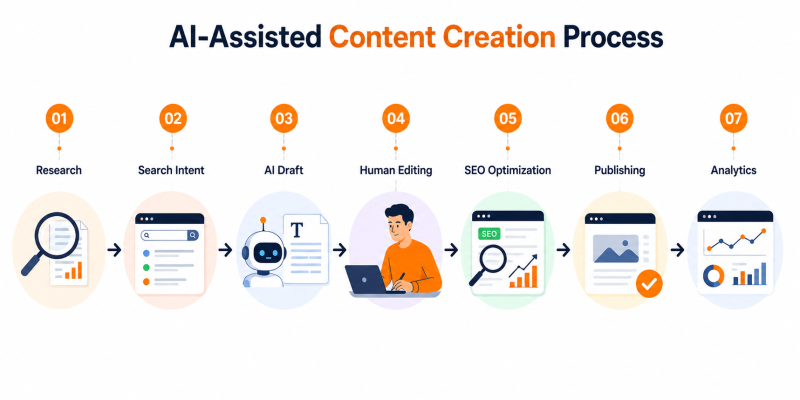
A professional workflow generally includes the following stages:
Audience Research: Understanding customer needs, business goals, and market competition before creating content.
Search Intent Analysis: Identifying whether readers require educational information, product comparisons, or purchasing guidance.
Content Planning: Preparing outlines that cover relevant questions, supporting topics, keywords, and logical content flow.
AI-Assisted Draft Creation: Using AI to prepare an initial draft based on detailed instructions.
Human Editing: Improving clarity, adding practical examples, refining brand voice, and removing repetitive language.
SEO Optimisation: Enhancing headings, internal links, keyword placement, metadata, image optimisation, and content structure.
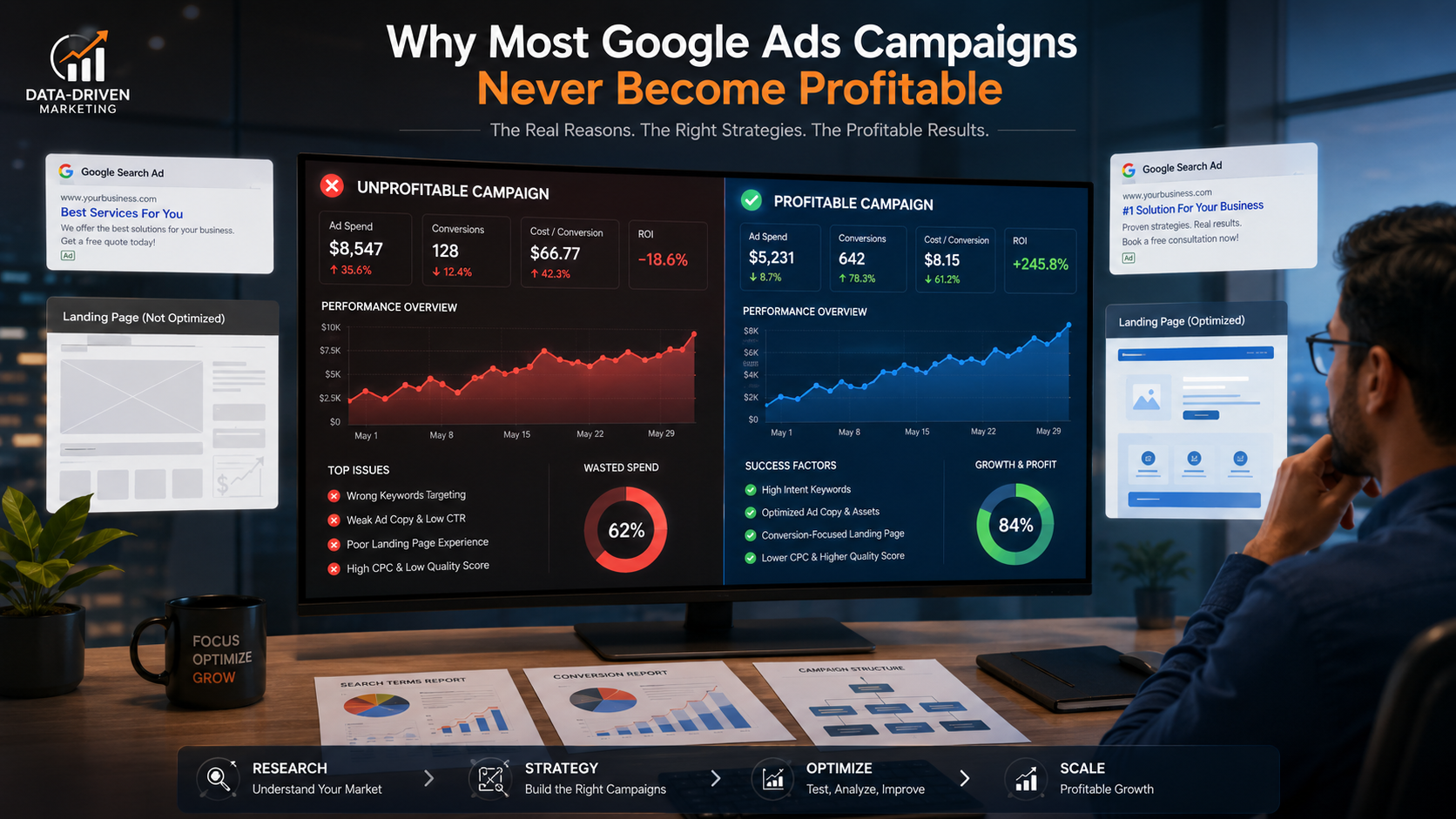
Performance Monitoring: Measuring rankings, engagement, traffic, and conversion rates to improve future content.
Conclusion
Artificial Intelligence has become an important component of modern digital marketing, offering significant improvements in speed and efficiency. However, successful marketing content depends on much more than automated text generation.
High-performing content is created through a combination of strategic planning, audience research, practical experience, search intent optimisation, and continuous refinement. AI supports these processes but cannot replace the critical thinking and expertise required to produce valuable, trustworthy, and conversion-focused content.
Organisations that integrate AI with professional marketing practices are better positioned to create content that ranks well in search engines, builds credibility, and generates sustainable business growth.