Introduction
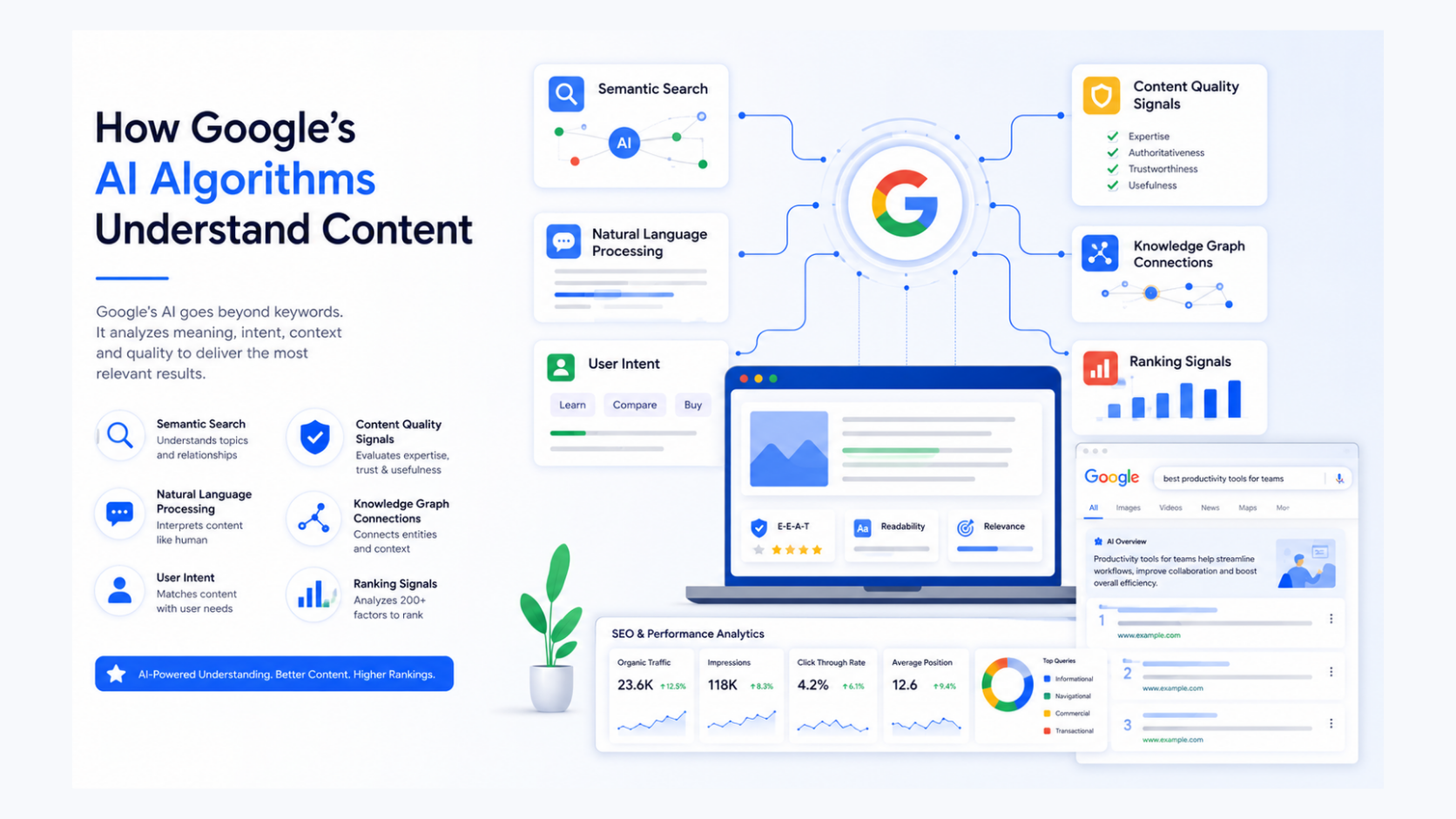
Search engines have changed dramatically over the last decade. Google is no longer matching pages based only on keywords. Today, its AI-powered algorithms analyze context, intent, relationships between words, user behavior, and overall content quality before deciding which pages deserve top rankings.
This shift means that simply adding a keyword multiple times isn’t enough. Websites that genuinely answer users’ questions, demonstrate expertise, and provide a great reading experience consistently outperform pages written solely for search engines.
Whether you’re a business owner, SEO professional, content writer, or digital marketer, understanding how Google’s AI interprets your content can help you create pages that perform better in organic search.
In this guide, you’ll learn how Google’s AI evaluates content, what ranking signals matter most, common mistakes to avoid, and practical ways to improve your website for long-term SEO success.
Why Google Uses AI to Understand Content
The way Google ranks websites has changed significantly over the years. In the early days of search engines, Google’s algorithms mainly focused on matching the exact words a user typed into the search box. If someone searched for “best running shoes,“ pages that repeated this exact phrase several times often had a better chance of appearing higher in the search results – even if the content wasn’t particularly useful.
However, this approach had limitations. Many websites began stuffing keywords into their content just to improve rankings, often creating articles that were difficult to read and provided little real value. Users frequently had to visit multiple websites before finding the information they actually needed.
To solve this problem, Google introduced Artificial Intelligence (AI) and Machine Learning into its search systems. Rather than simply matching keywords, Google’s AI tries to understand the meaning behind a search query and identify content that genuinely answers the user’s question.
Today, Google’s AI analyzes several important factors, including:
- User Intent: What is the person actually trying to find? Are they looking for information, comparing products, or ready to make a purchase?
- Context and Meaning: Instead of treating words individually, Google understands how they relate to each other within a sentence and across the entire page.
- Relationships Between Concepts: Google’s AI recognizes that related topics belong together. For example, an article about SEO is naturally connected to keywords, search intent, backlinks, content quality, and user experience.
- Content Quality: It evaluates whether the content is original, detailed, accurate, and helpful instead of simply checking how many times a keyword appears.
- Website Credibility: Google considers whether the website demonstrates expertise, has a trustworthy reputation, and provides reliable information.
- User Experience: Factors such as page speed, mobile responsiveness, readability, and how users interact with the page also influence rankings.
In simple terms, Google’s thinking has evolved.
Earlier, the question was:
“Does this page contain the keyword the user searched for?”
Today, the question is:
“Does this page provide the most helpful, accurate, and complete answer to the user’s query?”
This shift is why modern SEO is no longer about repeating keywords throughout an article. Instead, success comes from creating content that is informative, easy to understand, well-structured, and genuinely helpful. Websites that answer users’ questions clearly, cover topics in depth, and provide a positive reading experience are far more likely to perform well in Google’s AI-powered search results.
How Google's AI Understands Your Content
1. Natural Language Processing (NLP)
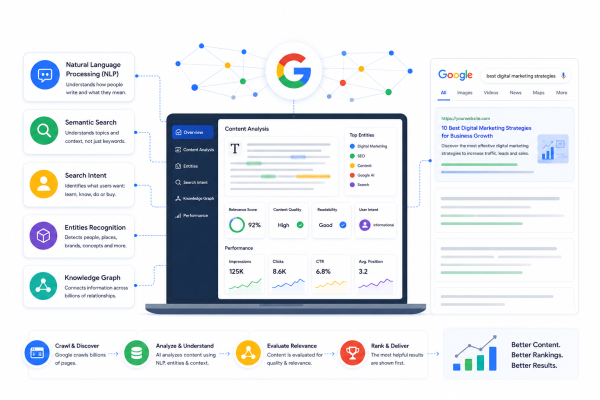
Google uses Natural Language Processing (NLP) to understand language similarly to how humans read.
Instead of reading isolated words, it understands:
- Sentence meaning
- Context
- Topic relationships
- Synonyms
- Intent
- Entity relationships
For example:
Search:
“How to improve website speed”
Google understands this is related to:
- Core Web Vitals
- PageSpeed Insights
- Image optimization
- Caching
- CDN
- Server response time
Even if your article doesn’t repeat the exact keyword many times, it can still rank because Google understands the overall topic.
2. Search Intent Analysis
Understanding user intent is one of Google’s strongest AI capabilities.
Different users searching similar phrases may expect different results.
Search Query | User Intent |
SEO Guide | Learn SEO |
Best SEO Agency | Compare agencies |
SEO Course Near Me | Purchase training |
SEO Tools | Find software |
Google AI Algorithm | Educational information |
Google matches pages according to intent rather than keywords alone.
Types of Search Intent
- Informational
- Navigational
- Commercial Investigation
- Transactional
Content that aligns with user intent generally ranks higher.
3. Entity Recognition
Google doesn’t just understand keywords.
It understands entities.
An entity can be:
- Person
- Company
- Place
- Product
- Technology
- Event
For example, if your article discusses:
- SEO
- Google Search
- Content Marketing
- AI
- Machine Learning
Google recognizes these as connected concepts.
This allows it to understand your content without relying solely on exact keyword repetition.
Important Google AI Systems That Influence Rankings
Google uses multiple AI-powered systems together.
I) RankBrain
RankBrain helps Google interpret unfamiliar or ambiguous searches.
It understands:
- Similar meanings
- Related phrases
- Search behavior
- User satisfaction
Example:
Search:
“Affordable DSLR camera for beginners”
Google understands this also relates to:
- Entry-level DSLR
- Beginner photography
- Budget camera
II) BERT
BERT helps Google understand words in context.
It looks at the complete sentence instead of individual words.
Example:
“Can someone else pick up my medicine for me?”
The meaning changes depending on small connecting words like:
- for
- to
- from
- with
BERT helps Google understand these relationships accurately.
III) MUM
MUM goes beyond text.
It can understand:
- Images
- Multiple languages
- Related topics
- Complex questions
This allows Google to provide richer search results.
How Semantic SEO Helps Google's AI Understand Your Content
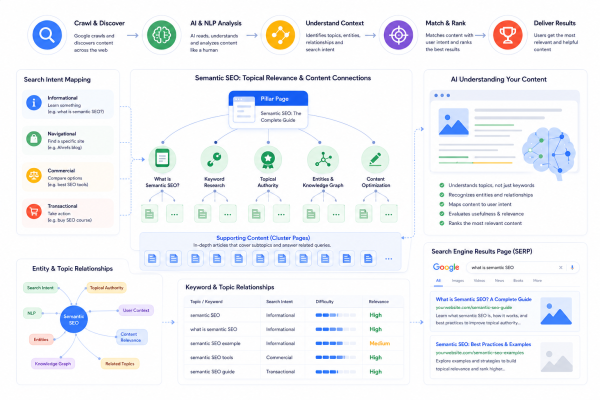
Semantic SEO is the practice of creating content that covers a topic comprehensively rather than focusing on a single keyword. Instead of trying to rank by repeatedly using one exact phrase, Semantic SEO helps search engines understand the broader meaning of your content and how different concepts are connected.
Google’s AI has become smart enough to recognize relationships between topics, entities, and user intent. It no longer depends solely on exact keyword matches to determine what a page is about. Instead, it analyzes the overall context of your content to decide whether it provides a complete answer to a user’s query.
For example, if you’re writing about Google AI, don’t limit your content to that keyword alone. Naturally include related topics such as:
- Search Intent
- Natural Language Processing (NLP)
- Entity Recognition
- RankBrain and BERT
- Helpful Content
- E-E-A-T
- Technical SEO
- User Experience
By connecting these related concepts, you create topical depth, making your content more informative and valuable. Google’s AI recognizes these relationships and understands that your page provides a comprehensive explanation of the subject.
In simple terms, Semantic SEO is about writing for a topic, not just a keyword. This approach improves your chances of ranking for multiple related searches while providing a better experience for your readers.
Conclusion
Google’s AI algorithms have transformed how search engines evaluate content. Rather than depending solely on exact keywords, modern AI systems analyze language, context, search intent, semantic relationships, entities, and overall content quality.
Content creators who understand these principles can build articles that provide genuine value to readers while meeting Google’s quality standards. By focusing on user needs, comprehensive topic coverage, clear structure, and E-E-A-T principles, websites can achieve stronger organic visibility and maintain long-term search performance.
Ultimately, successful SEO is no longer about optimizing for algorithms alone—it is about creating content that effectively answers user questions and delivers a meaningful experience.