
Introduction
Many people use the terms positioning, branding, and marketing interchangeably. Although they are closely connected, they serve different purposes in building and growing a business.
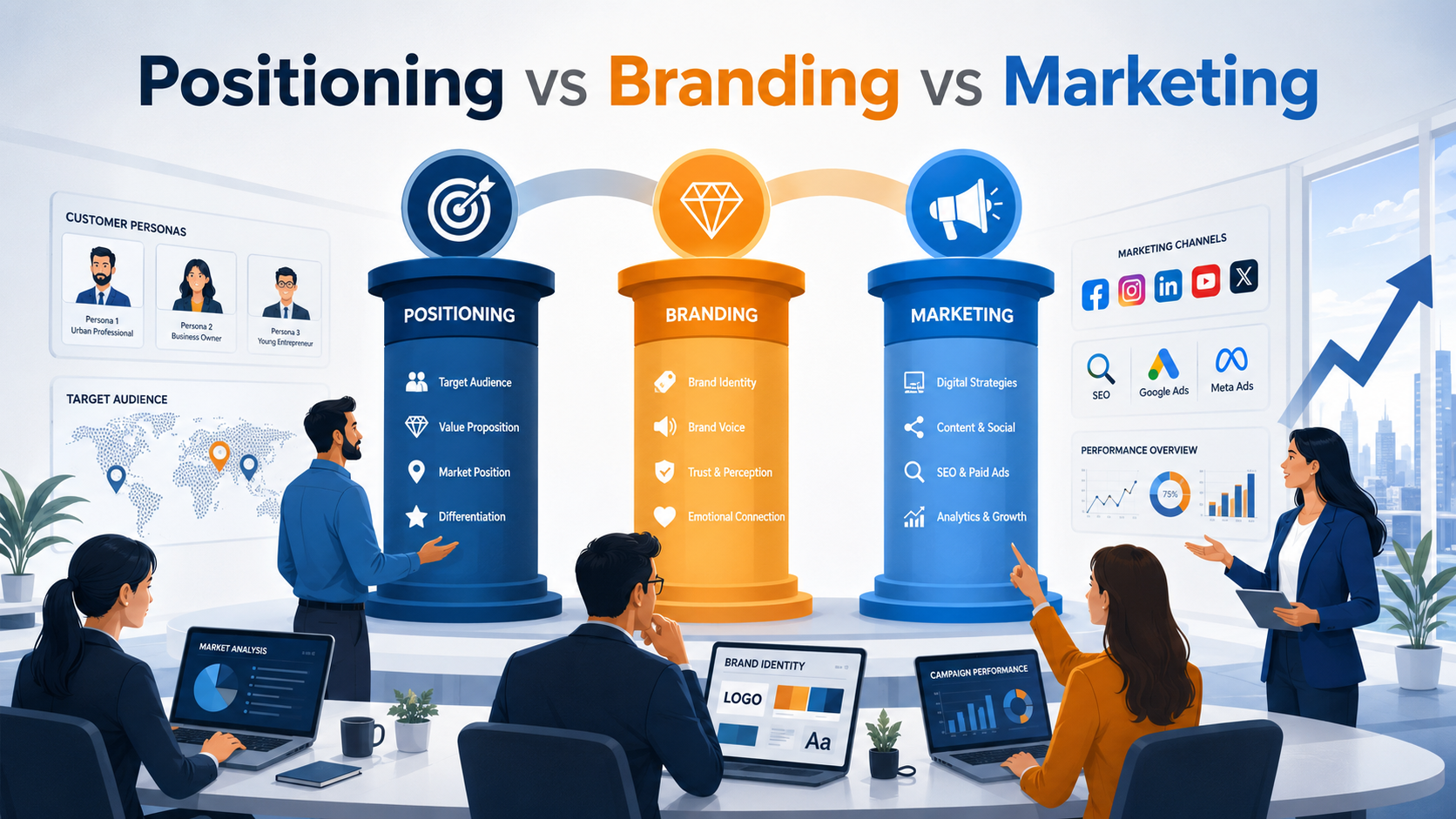
Every successful business follows a sequence:
- First, it decides how it wants customers to perceive it (Positioning).
- Next, it creates an identity that reflects that perception (Branding).
- Finally, it communicates its value to potential customers (Marketing).
Without clear positioning, branding lacks direction. Without branding, marketing lacks consistency. Without marketing, even the strongest brand may remain unnoticed.
Understanding the relationship between these three concepts helps businesses build customer trust, improve market presence, and achieve sustainable growth.
What is Positioning?
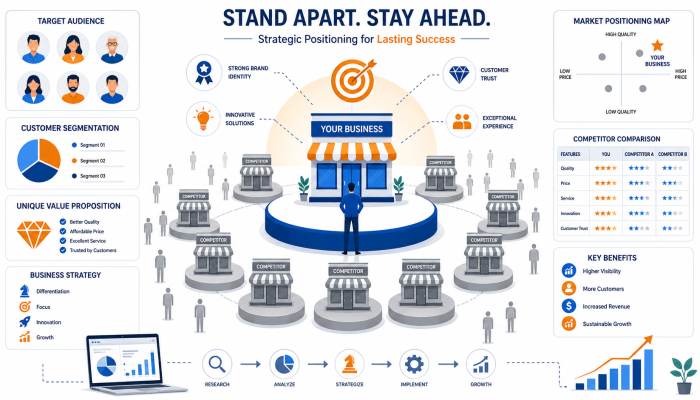
Positioning is the process of establishing a unique place for a business, product, or service in the minds of its target customers.
It defines how a business wants to be perceived compared to its competitors.
Positioning focuses on answering one fundamental question:
“Why should customers choose this business instead of another?”
A well-defined positioning strategy helps customers immediately understand the value a business offers.
Objectives of Positioning:-
Differentiate your business from competitors
✔ Create a unique and memorable market identity
✔ Address customer needs effectively
✔ Communicate a clear and compelling value proposition
✔ Build a sustainable long-term competitive advantage
Key Elements of Positioning:-
i) Target Audience: Identifying the specific group of customers the business wants to serve.
ii) Customer Problem: Understanding the challenges or needs that customers experience.
iii) Unique Value Proposition: Defining the specific benefit that distinguishes the business from competitors.
iv) Competitive Advantage: Highlighting strengths that competitors cannot easily replicate.
v) Brand Promise: Clearly communicating what customers can consistently expect.
Example of Positioning:-
- Apple positions itself as an innovative and premium technology company.
- Volvo positions itself as a leader in automotive safety.
- Nike positions itself as a brand that inspires athletic performance and achievement.
In each case, the positioning influences customer perception before any purchase decision is made.
What is Branding?
Branding is the process of creating a distinct identity for a business.
It represents how customers recognize, remember, and emotionally connect with the organization.
Branding extends far beyond a company logo. It includes every interaction a customer has with the business.
A strong brand creates familiarity, trust, and credibility over time.
Components of Branding
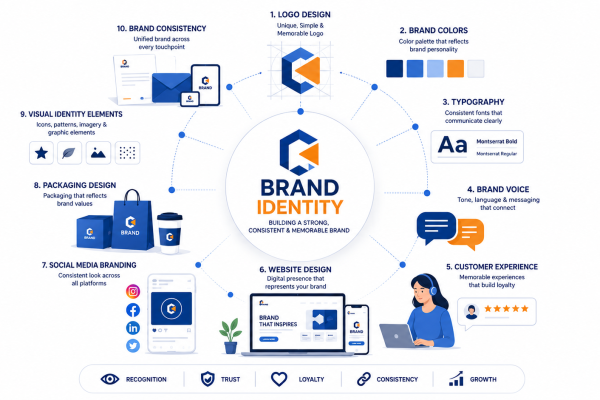
Branding consists of several interconnected elements, including:
- Brand name
- Logo
- Colour palette
- Typography
- Brand voice
- Messaging
- Website design
- Packaging
- Customer service
- Company values
- Visual identity
- Overall customer experience
Each component contributes to shaping the customer’s perception of the business.
Objectives of Branding
- Build customer trust
- Increase brand recognition
- Create emotional connections
- Improve customer loyalty
- Maintain consistency across communication channels
- Strengthen business reputation
What is Marketing?
Marketing refers to the activities used to promote products or services to the target audience.
Its primary objective is to create awareness, generate interest, attract customers, and encourage purchases.
Marketing communicates the value established through positioning and expressed through branding.
Major Areas of Marketing
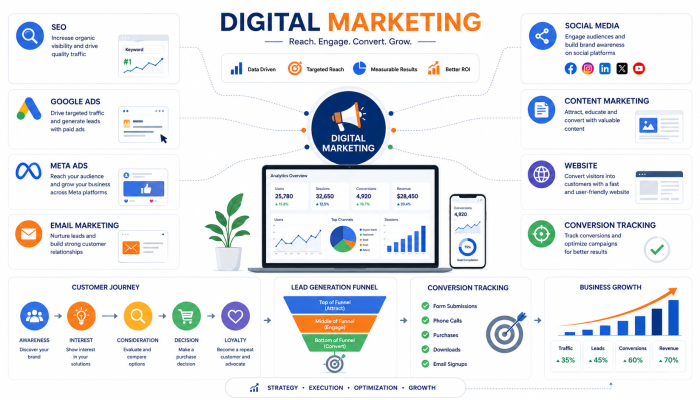
Modern marketing includes various channels, such as:
- Search Engine Optimization (SEO)
- Content Marketing
- Social Media Marketing
- Email Marketing
- Google Ads
- Meta Advertising
- Influencer Marketing
- Video Marketing
- Local SEO
- WhatsApp Marketing
- Affiliate Marketing
Each channel supports business growth by reaching potential customers through different platforms.
Objectives of Marketing
Marketing aims to:
- Increase brand awareness
- Generate leads
- Drive website traffic
- Improve customer engagement
- Increase sales
- Build customer relationships
- Support long-term business growth
Comparison Between Positioning, Branding, and Marketing

Aspect | Positioning | Branding | Marketing |
Definition | Establishes a unique place in the customer’s mind | Creates the identity of the business | Promotes products and services |
Primary Focus | Differentiation | Identity and perception | Communication and promotion |
Main Objective | Stand out from competitors | Build trust and recognition | Generate awareness and sales |
Customer Question | Why should I choose this brand? | Who is this brand? | Where can I find this product? |
Time Horizon | Long-term | Long-term | Continuous |
Outcome | Competitive advantage | Customer loyalty | Business growth |
Relationship Between Positioning, Branding, and Marketing
Although positioning, branding, and marketing have different purposes, they function as interconnected business strategies.
I) Positioning Comes First: Positioning establishes the business’s place in the market.
Without positioning, businesses struggle to define their uniqueness.
II) Branding Builds Upon Positioning: Once positioning is established, branding creates a visual and emotional identity that reflects the desired market perception.
Every branding decision should support the positioning strategy.
III) Marketing Communicates Both: Marketing shares the brand’s message with the intended audience through various promotional channels.
Effective marketing consistently communicates the business positioning while reinforcing its brand identity.
How Positioning, Branding, and Marketing Work Together
These three concepts function as a continuous process.
Positioning identifies the business’s unique value.
↓
Branding communicates that value through identity and customer experience.
↓
Marketing promotes the business using appropriate communication channels.
When all three remain aligned, businesses create stronger customer relationships and improve long-term performance.
Conclusion
Positioning, branding, and marketing are three distinct yet interconnected pillars of business success. Positioning determines how a business differentiates itself in the marketplace. Branding transforms that positioning into a recognizable identity, while marketing communicates the brand’s value to the target audience through various promotional channels.
Businesses that develop a clear positioning strategy, maintain consistent branding, and implement effective marketing activities are better equipped to attract customers, build trust, and achieve sustainable long-term growth. Rather than viewing these concepts as separate activities, organizations should treat them as complementary strategies that work together to create lasting competitive advantage.