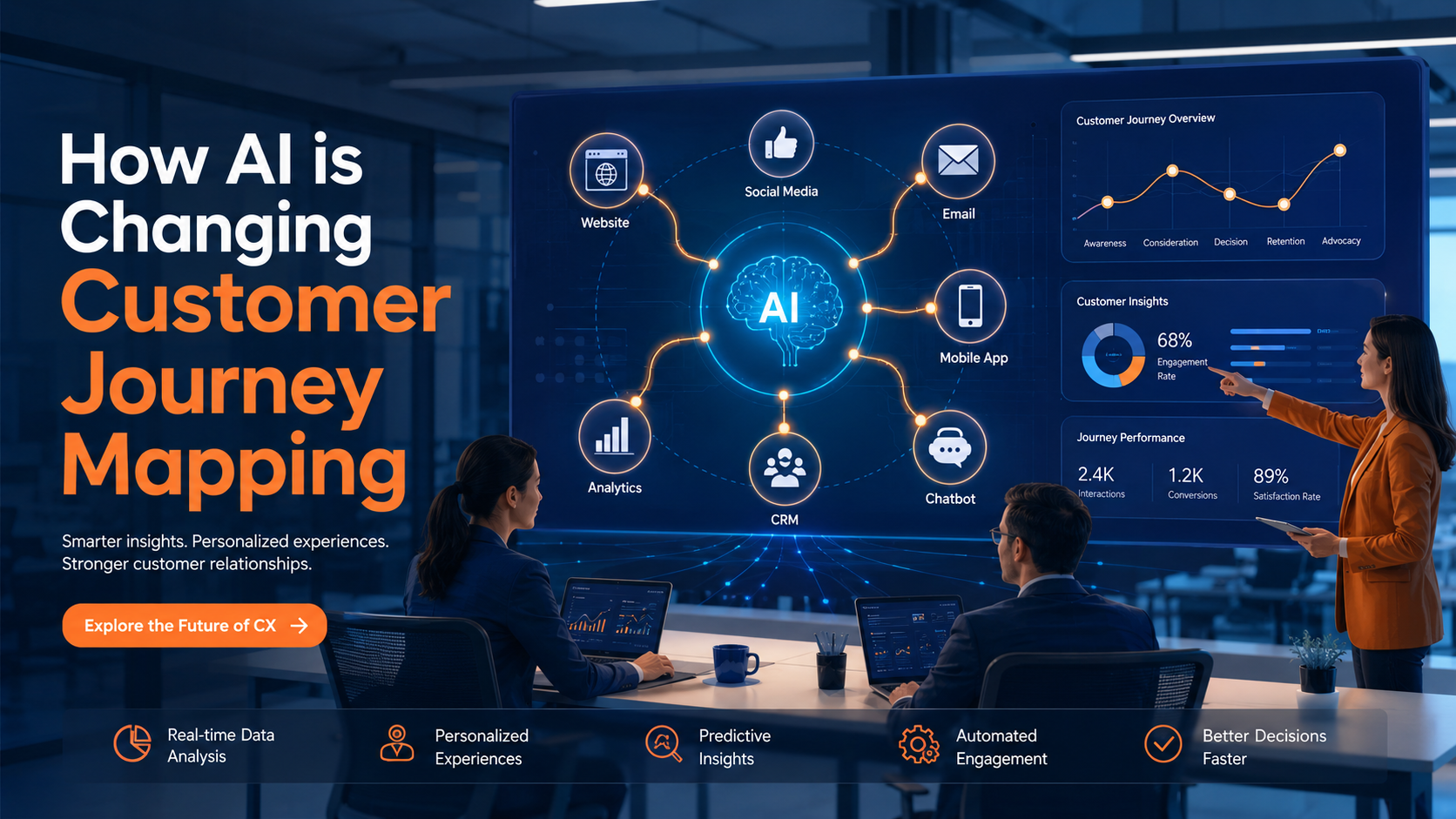
Customer journey mapping has always been an essential part of marketing. It helps businesses understand how customers interact with a brand from the first point of contact until after a purchase is made. Traditionally, marketers created customer journey maps using surveys, customer interviews, sales reports, and historical data. While these methods provided useful insights, they were often time-consuming and quickly became outdated because customer behavior changes continuously.
The rise of Artificial Intelligence (AI) has significantly transformed customer journey mapping. Instead of relying only on past information, AI enables businesses to analyze customer interactions in real time, identify behavioral patterns, predict future actions, and deliver personalized experiences across multiple channels.
This article explains the concept of AI-powered customer journey mapping, how it works, its benefits, challenges, practical applications, and why it has become an important part of modern digital marketing.
What is Customer Journey Mapping?
Customer journey mapping is the process of visually representing every interaction a customer has with a business throughout the buying process. It helps organizations understand customer needs, expectations, emotions, and behaviors at each stage of the journey.
The primary objective of customer journey mapping is to improve customer experience by identifying opportunities to provide better communication, services, and support.
Typical Stages of a Customer Journey
Stage | Description |
Awareness | Customer becomes aware of a product or service. |
Consideration | Customer researches available options and compares alternatives. |
Decision | Customer evaluates information before making a purchase decision. |
Purchase | Customer completes the transaction. |
Retention | Business engages the customer after purchase to encourage repeat business. |
Advocacy | Satisfied customers recommend the brand to others. |
Understanding Artificial Intelligence (AI) in Marketing
Artificial Intelligence refers to computer systems that can perform tasks that typically require human intelligence. These tasks include learning from data, identifying patterns, making predictions, understanding language, and automating decisions.
In digital marketing, AI helps businesses analyze large volumes of customer data and make informed marketing decisions without relying solely on manual analysis.
Some commonly used AI technologies include:
- Machine Learning
- Predictive Analytics
- Natural Language Processing (NLP)
- Recommendation Engines
- Conversational AI (Chatbots)
- Computer Vision
These technologies work together to improve customer experiences and marketing performance.
Why Traditional Customer Journey Mapping Has Limitations
Although traditional customer journey mapping has been widely used for many years, it has several limitations.
1. Static Customer Journeys: Traditional journey maps are created based on historical information and are updated only occasionally. Customer behavior changes frequently, making these maps less accurate over time.
2. Limited Data Sources: Manual journey mapping usually considers only a few customer touchpoints, such as website visits or sales data. It often ignores interactions across multiple digital platforms.
3. Time-Consuming Process: Collecting customer feedback, analyzing reports, and updating journey maps require considerable time and effort.
4. Lack of Personalization: Traditional methods generally assume that all customers follow the same buying process, whereas every customer behaves differently.
How AI is Changing Customer Journey Mapping
Artificial Intelligence has introduced a more intelligent and dynamic approach to customer journey mapping. Instead of depending on assumptions, AI continuously analyzes customer interactions and updates journey maps automatically.
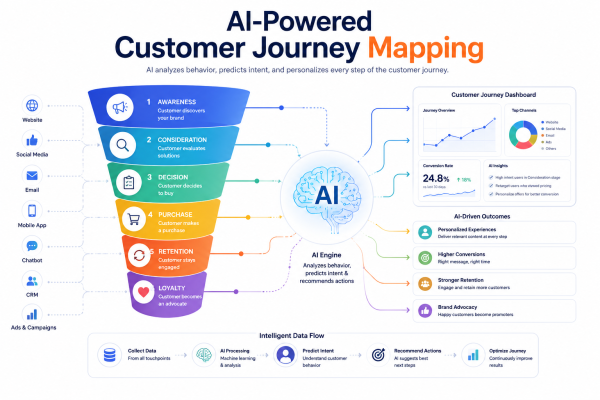
1. Real-Time Customer Behavior Analysis
One of the most significant advantages of AI is its ability to analyze customer activities as they happen.
AI continuously tracks various customer interactions, including:
- Website visits
- Product searches
- Page views
- Clicks
- Scroll behavior
- Video engagement
- Mobile app usage
- Email interactions
This real-time analysis allows businesses to understand customer interests immediately rather than waiting for monthly reports.
2. Predictive Customer Analytics
AI not only analyzes past behavior but also predicts future customer actions.
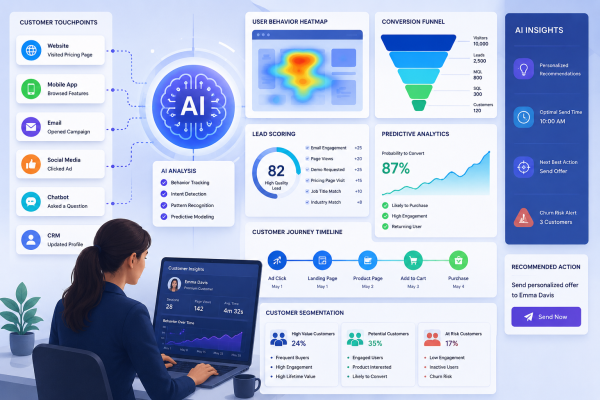
By studying behavioral patterns, AI can estimate whether a customer is likely to:
- Purchase a product
- Abandon the shopping cart
- Cancel a subscription
- Become a repeat customer
- Stop engaging with the business
These predictions help businesses take proactive actions before opportunities are lost.
3. Personalized Customer Experiences
Modern customers expect personalized experiences rather than generic marketing messages.
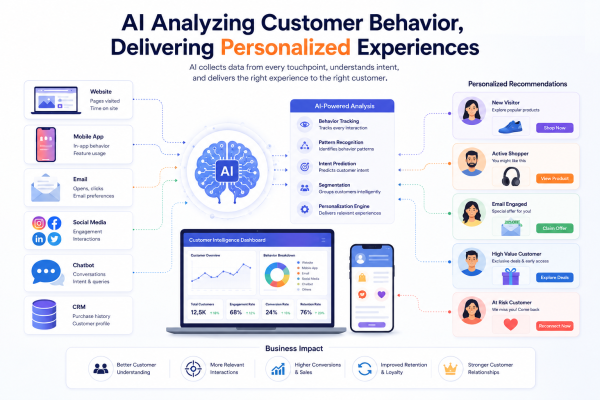
AI creates unique customer journeys by considering factors such as:
- Browsing history
- Purchase history
- Interests
- Geographic location
- Device type
- Customer preferences
- Previous interactions
As a result, every customer receives content, offers, and recommendations that match their individual interests.
4. Intelligent Customer Segmentation
Traditional customer segmentation often relies on basic demographic information such as age, gender, or location.
AI performs behavioral segmentation by grouping customers based on:
- Purchase frequency
- Website activity
- Product interests
- Buying intent
- Customer lifetime value
- Engagement level
This enables marketers to create highly relevant campaigns for different customer groups.
5. Identification of Customer Drop-Off Points
Many customers begin their buying journey but do not complete it.
AI identifies the exact stage where customers leave the journey.
Common drop-off points include:
- Slow website loading
- Complicated registration forms
- High product prices
- Poor mobile experience
- Lack of trust signals
- Confusing checkout process
By identifying these issues, businesses can optimize the customer experience and improve conversion rates.
AI Across Different Customer Journey Stages
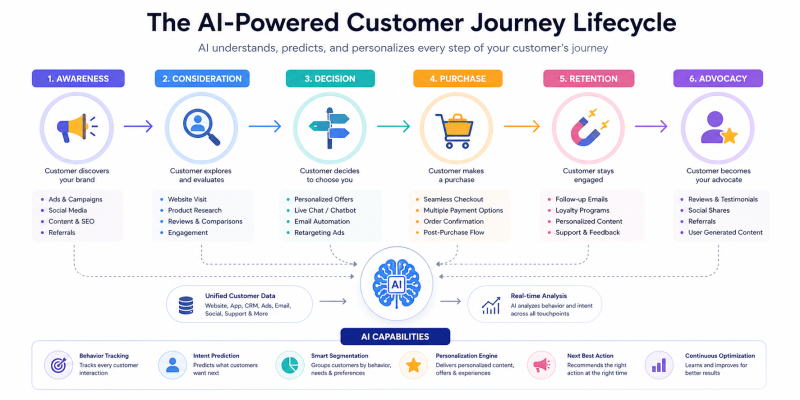
Customer Journey Stage | AI Contribution |
Awareness | Identifies target audience and recommends suitable content. |
Consideration | Suggests relevant products based on customer interests. |
Decision | Predicts purchase intent and recommends personalized offers. |
Purchase | Optimizes checkout experience and reduces cart abandonment. |
Retention | Automates follow-up emails and customer engagement campaigns. |
Loyalty | Identifies satisfied customers and promotes referral programs. |
Technologies Used in AI Customer Journey Mapping
Several AI technologies contribute to effective customer journey mapping.
i) Machine Learning: Machine Learning enables systems to learn from customer behavior and improve recommendations without manual programming.
ii) Predictive Analytics: Predictive Analytics uses historical customer data to forecast future actions and buying behavior.
iii) Natural Language Processing (NLP): NLP helps AI understand customer conversations, reviews, emails, and social media comments.
It assists businesses in analyzing customer sentiment and identifying common concerns.
iv) Recommendation Systems: Recommendation engines analyze customer interests and suggest products or services that are most relevant.
Examples include product recommendations on eCommerce websites and personalized video suggestions.
v) Conversational AI: AI-powered chatbots provide instant customer support and guide users throughout their buying journey.
Benefits of AI in Customer Journey Mapping
Implementing AI offers numerous advantages for businesses.
i) Improved Customer Experience: AI provides relevant information based on customer behavior, making interactions more meaningful.
ii) Better Decision Making: Real-time insights help businesses make faster and more accurate marketing decisions.
iii) Increased Conversion Rates: Personalized experiences encourage customers to complete purchases.
iv) Higher Marketing ROI: Businesses can focus their marketing budgets on audiences most likely to convert.
v) Enhanced Customer Retention: AI identifies customers at risk of leaving and recommends appropriate engagement strategies.
vi) Data-Driven Marketing: Marketing decisions become based on factual customer behavior rather than assumptions.
Conclusion
Artificial Intelligence has fundamentally changed the way businesses understand and manage customer journeys. Traditional customer journey maps were largely static and based on historical data, whereas AI-powered journey mapping provides dynamic, real-time insights into customer behavior across multiple touchpoints.
By combining technologies such as machine learning, predictive analytics, natural language processing, and recommendation systems, businesses can create highly personalized customer experiences, identify opportunities for improvement, and make informed marketing decisions. While challenges such as data privacy and technology integration remain important considerations, the advantages of AI-powered customer journey mapping make it an essential strategy for organizations seeking sustainable growth in today’s digital environment.