Google Ads is one of the most powerful digital advertising platforms available today. It enables businesses to reach customers who are actively searching for products or services on Google. Unlike traditional advertising, where businesses promote their products to a broad audience, Google Ads targets users based on their search intent, making it one of the most effective forms of online marketing.
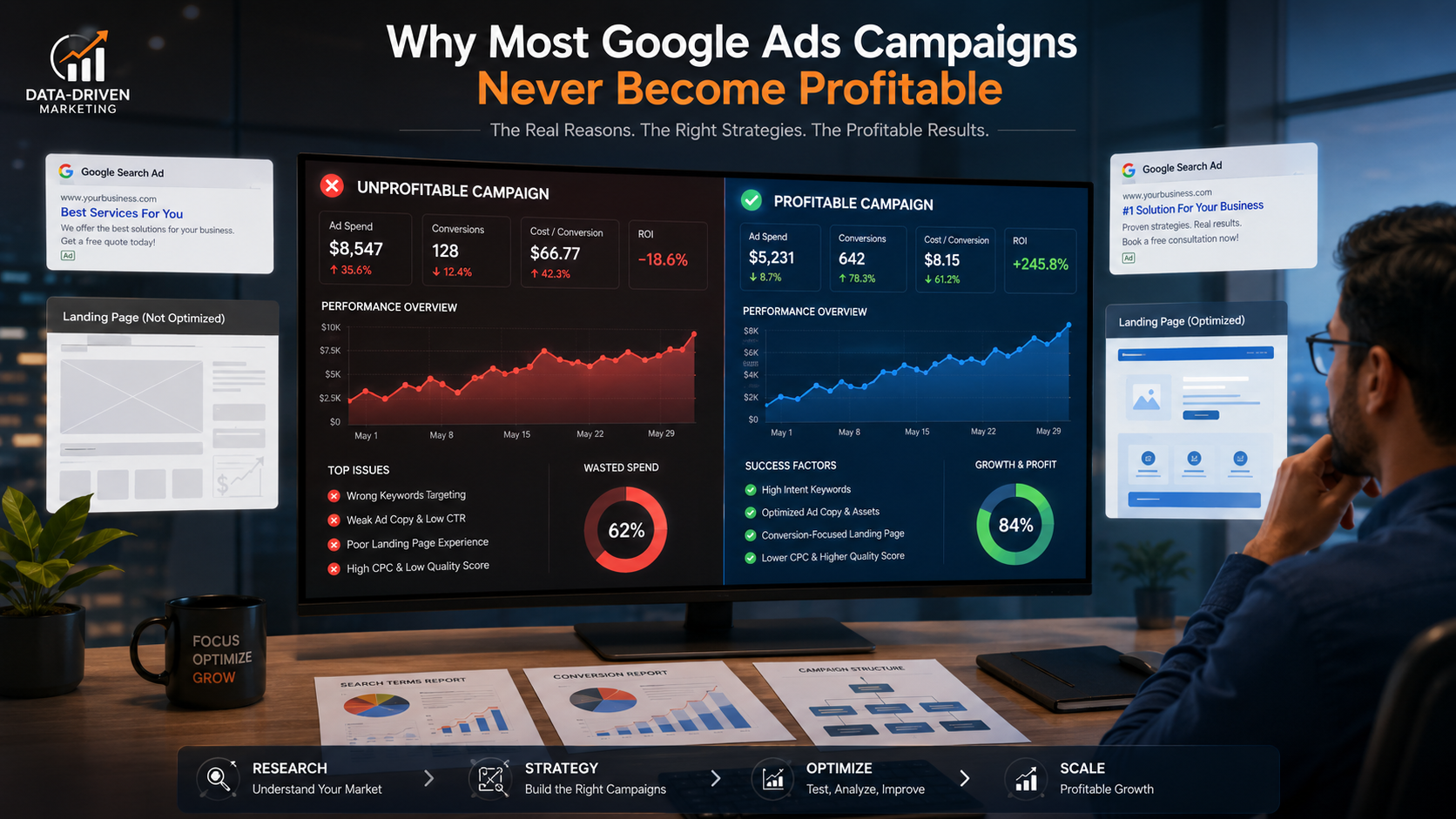
Despite its potential, many businesses fail to achieve profitable results from Google Ads. According to industry observations, a significant percentage of advertisers discontinue their campaigns within a few months because they do not receive the expected return on investment (ROI). This often leads to the misconception that Google Ads is ineffective. In reality, the issue usually lies in campaign strategy, implementation, and ongoing optimization rather than the platform itself.
A profitable Google Ads campaign is not created simply by launching advertisements. It requires a systematic approach involving keyword research, audience targeting, compelling advertisements, optimized landing pages, accurate tracking, and continuous performance improvement. Understanding these factors is essential for businesses aiming to generate consistent leads and sales through paid advertising.
I) Understanding Google Ads Profitability
Before analyzing why campaigns fail, it is important to understand what profitability means in Google Ads.
A campaign is considered profitable when the revenue generated from customers acquired through advertising exceeds the total advertising cost and associated business expenses. Measuring profitability involves evaluating metrics such as Cost Per Click (CPC), Cost Per Acquisition (CPA), Conversion Rate, Return on Ad Spend (ROAS), and overall Return on Investment (ROI).
Many businesses mistakenly judge campaign success based solely on the number of clicks or website visitors. However, traffic alone does not generate profit. The true objective is to attract qualified visitors who are likely to convert into paying customers.
II) The Relationship Between Google Ads and the Customer Journey
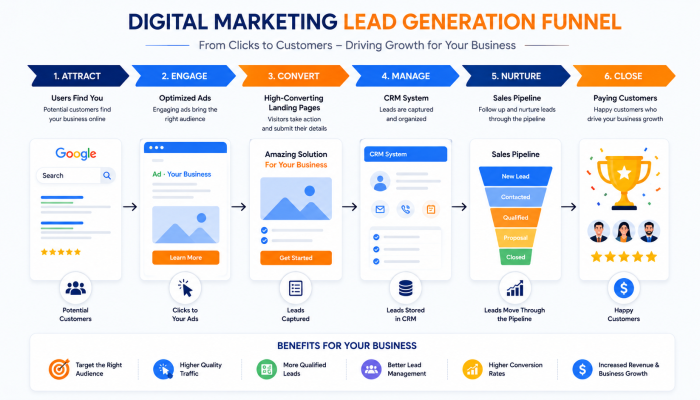
Google Ads represents only one stage of the customer acquisition process. A successful advertising campaign depends on multiple interconnected components working together.
Stage | Purpose |
Search Query | User searches for a product or service |
Advertisement | Attracts relevant visitors |
Landing Page | Encourages visitors to take action |
Sales Process | Converts leads into customers |
Customer Experience | Builds long-term relationships |
If any stage of this process is weak, campaign profitability declines regardless of advertising spend.
III) Reasons Why Most Google Ads Campaigns Fail
1. Poor Keyword Selection
Keyword selection forms the foundation of every Google Ads campaign. Businesses often choose keywords based solely on high search volume rather than purchase intent. As a result, advertisements receive clicks from users who are not interested in buying the product or service.
Broad keywords generally attract a diverse audience with different intentions, many of whom may simply be seeking information rather than making a purchase.
Effective campaigns focus on highly relevant and intent-based keywords that closely match the products or services being offered.
2. Lack of Search Intent Understanding
Search intent refers to the purpose behind a user’s search query. Every search generally falls into one of three categories:
Search Intent | Example |
Informational | What is Google Ads? |
Commercial | Best Google Ads Agency |
Transactional | Hire Google Ads Expert |
Businesses targeting transactional keywords usually achieve higher conversion rates because these users are closer to making a purchasing decision.
Ignoring search intent often results in low-quality traffic and poor campaign performance.
3. Sending Visitors to the Homepage
One of the most common mistakes is directing paid traffic to the business homepage.
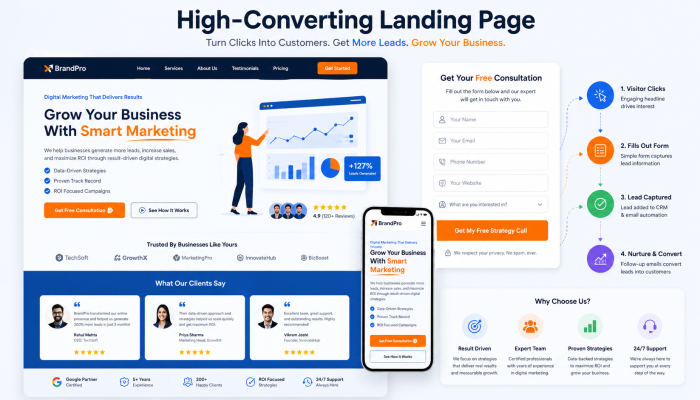
A homepage typically contains multiple navigation options, service descriptions, company information, blogs, and contact pages. This variety can distract visitors from completing the desired action.
Dedicated landing pages are designed with a single objective, such as collecting enquiries, booking consultations, or generating sales. Such pages generally provide higher conversion rates because they minimize distractions and focus on a specific call-to-action.
4. Ineffective Advertisement Copy
The quality of advertisement copy significantly influences campaign performance.
Generic advertisements containing phrases such as “Best Service,” “Affordable Price,” or “High Quality” fail to differentiate a business from competitors.
Effective advertisements clearly communicate unique benefits, address customer problems, and encourage users to click by presenting compelling reasons to choose the advertised service.
Relevant advertisements also improve Google’s Quality Score, which can reduce advertising costs.
5. Poor Landing Page Experience
A landing page plays a critical role in converting visitors into leads or customers.
Common landing page issues include:
- Slow loading speed
- Poor mobile responsiveness
- Weak call-to-action
- Excessive text
- Lack of trust signals
- Complicated forms
Even highly targeted traffic cannot generate profitable results if visitors encounter a poor user experience.
6. Absence of Conversion Tracking
Many advertisers launch campaigns without implementing conversion tracking.
Without tracking systems such as Google Analytics 4 and Google Ads Conversion Tracking, businesses cannot determine:
- Which keywords generate enquiries
- Which advertisements produce sales
- Which devices perform best
- Which locations generate profitable customers
Data-driven decision-making is impossible without accurate performance measurement.
7. Focusing on Clicks Instead of Business Results
High website traffic does not necessarily indicate campaign success.
Businesses often celebrate increased click volumes while overlooking lead quality and customer acquisition.
The primary objective should always be generating profitable customers rather than maximizing website visits.
Campaign optimization should therefore prioritize conversion rate, customer acquisition cost, and revenue generation.
8. Failure to Use Negative Keywords
Negative keywords prevent advertisements from appearing for irrelevant searches.
Without negative keywords, businesses may receive unnecessary clicks from users searching for:
- Free resources
- Job opportunities
- Internships
- Course notes
- Salary information
These clicks increase advertising costs without contributing to business growth.
Regular search term analysis helps eliminate irrelevant traffic and improve overall campaign efficiency.
9. Improper Budget Allocation
Effective budget management is essential for campaign profitability.
Some advertisers distribute their budget equally across numerous campaigns regardless of individual performance.
A more effective strategy involves allocating larger budgets to high-performing campaigns while reducing expenditure on campaigns that consistently underperform.
This approach improves overall Return on Ad Spend (ROAS).
10. Lack of Continuous Optimization
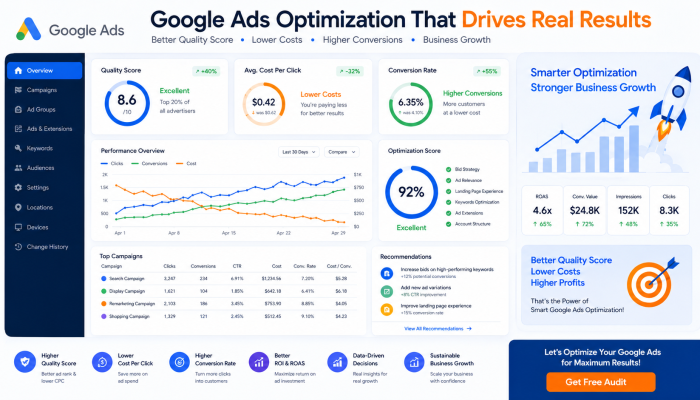
Google Ads requires continuous monitoring and improvement.
Successful advertisers regularly evaluate campaign performance and make adjustments based on collected data.
Optimization activities include:
- Updating keyword lists
- Testing multiple advertisement variations
- Improving landing pages
- Reviewing search terms
- Adjusting bidding strategies
- Monitoring Quality Score
- Testing different call-to-action messages
Continuous optimization helps reduce costs while improving conversion rates over time.
IV) Essential Components of a Profitable Google Ads Campaign
A successful campaign consists of several interconnected elements working together.
Component | Purpose |
Keyword Research | Attract relevant search traffic |
Search Intent Analysis | Reach potential customers |
Compelling Ad Copy | Increase click-through rate |
Landing Page Optimization | Improve conversions |
Conversion Tracking | Measure campaign success |
Negative Keywords | Eliminate irrelevant traffic |
Ongoing Optimization | Improve long-term profitability |
V) Best Practices for Improving Google Ads Profitability
Businesses seeking better advertising performance should consider the following practices:
- Conduct detailed keyword research before launching campaigns.
- Focus on high-intent search queries.
- Develop dedicated landing pages for each campaign.
- Install Google Analytics 4 and conversion tracking.
- Use negative keywords regularly.
- Monitor campaign performance weekly.
- Continuously test advertisements and landing pages.
- Optimize campaigns based on measurable data rather than assumptions.
- Improve website speed and mobile usability.
- Review Quality Score and bidding strategies regularly.
Implementing these practices creates a stronger foundation for long-term advertising success.
Conclusion
Google Ads remains one of the most effective platforms for generating qualified leads and driving business growth when managed strategically. However, profitability is not achieved simply by creating advertisements or increasing advertising budgets.
Successful campaigns rely on a structured approach that combines detailed keyword research, understanding search intent, persuasive ad copy, optimized landing pages, conversion tracking, and continuous performance analysis. Businesses that invest time in improving every stage of the customer journey are more likely to reduce advertising costs, increase conversion rates, and achieve sustainable returns on investment.
Instead of viewing Google Ads as a quick solution for instant sales, organizations should approach it as a long-term marketing system that requires consistent monitoring, testing, and optimization. By following proven best practices and making informed decisions based on data, businesses can transform underperforming campaigns into profitable growth channels.