Introduction: Why Cost Per Lead Matters More Than Ever
Every marketer, business owner, and performance advertiser is chasing the same goal — more leads at lower cost.
But in 2026, rising ad competition, increasing CPMs, and stricter platform algorithms have made one thing very clear:
You can’t always win by increasing budget. You win by improving efficiency.
Reducing Cost Per Lead (CPL) without increasing budget is no longer a nice-to-have skill — it’s a core performance marketing competency.
In this guide, we’ll break down practical, proven, real-world strategies that actually reduce CPL — without fluff, without theory, and without unrealistic hacks.
What Is Cost Per Lead (CPL)?
Cost Per Lead = Total Ad Spend ÷ Total Leads Generated
Example:
If you spend ₹10,000 and generate 100 leads →
CPL = ₹100
Your goal:
👉 Generate more leads at the same spend
or
👉 Generate same leads at lower spend
Both reduce CPL.
Why Increasing Budget Is Not the Right Solution
Most advertisers think:
“If leads are costly, increase budget.”
This often leads to:
- Poor quality leads
- Faster budget burn
- Lower ROI
- No scalability
Smart marketers optimise before they scale.
Core Framework: How CPL Actually Reduces
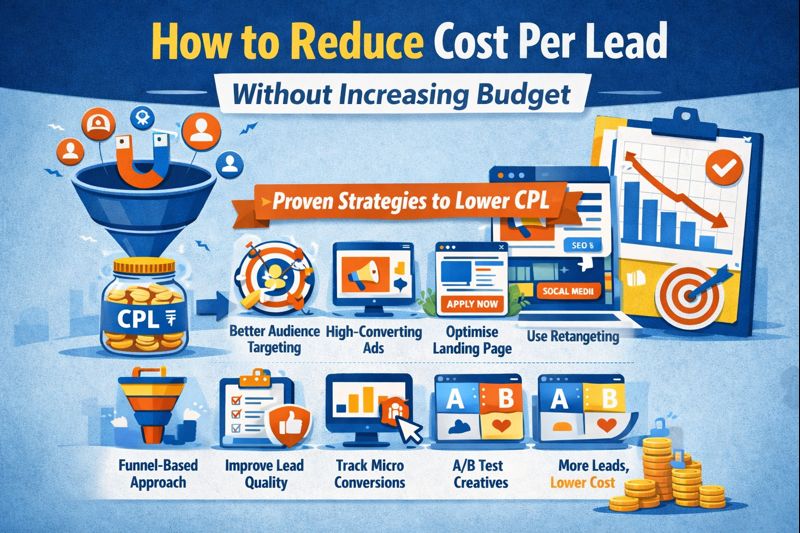
Your CPL reduces when you improve any of these three stages:
- Targeting quality
- Ad engagement
- Landing page conversion
Most people focus only on ads.
Real optimisation happens across the entire funnel.
1. Fix Your Targeting Before Touching Your Creatives
Why Targeting Controls CPL
Even the best ad will fail if it’s shown to the wrong audience.
If your leads are:
- Irrelevant
- Low quality
- Non-converting
Your CPL will automatically rise.
Smart Targeting Techniques for 2026
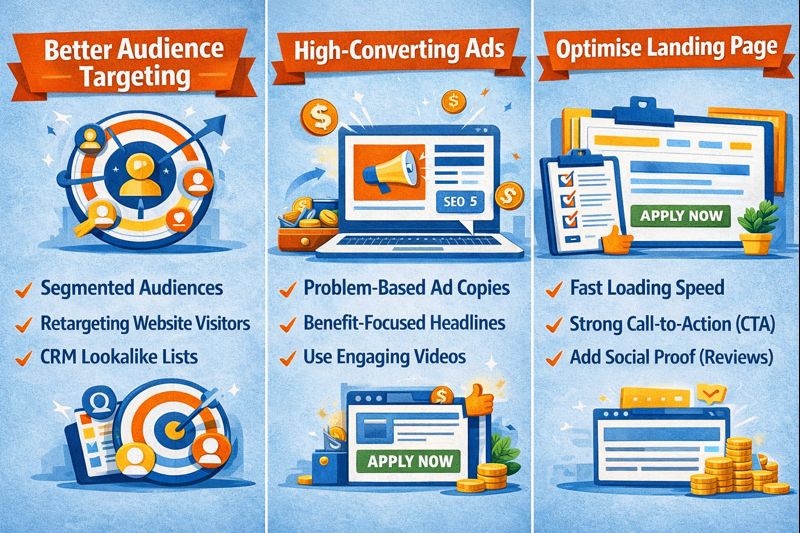
➜ Use First-Party Data
- Website visitors
- Past leads
- CRM lists
- WhatsApp contacts
- Email subscribers
These convert cheaper than cold audiences.
➜ Segment Instead of Broad Targeting
Instead of:
Digital Marketing Course → Everyone aged 18–40
Try:
- Students after 12th
- Fresh graduates
- Working professionals
- Business owners
Each group needs separate ad angles.
➜ Use High-Intent Signals
Target users who:
- Visited pricing page
- Watched 50%+ video
- Clicked WhatsApp button
- Engaged with posts
These audiences generate lowest CPL.
2. Improve Ad Engagement to Lower CPC (Direct CPL Impact)
Why Engagement Matters
Higher engagement → Higher Quality Score → Lower CPC → Lower CPL
Platforms reward ads people like to interact with.
High-Conversion Ad Creative Strategies
➜ Problem-First Copywriting
Instead of:
Learn Digital Marketing Course
Try:
Still struggling to get job calls after learning digital marketing?
Problem-based ads attract high-intent users.
➜ Use Real-Life Context
- Student struggles
- Job switching fears
- Salary growth concerns
- Business lead problems
Relatable ads = cheaper leads.
➜ Use Video More Than Static
In 2026:
- Short-form videos generate
40–65% lower CPL than static images.
Why?
Because videos:
- Build trust faster
- Explain value better
- Filter junk clicks
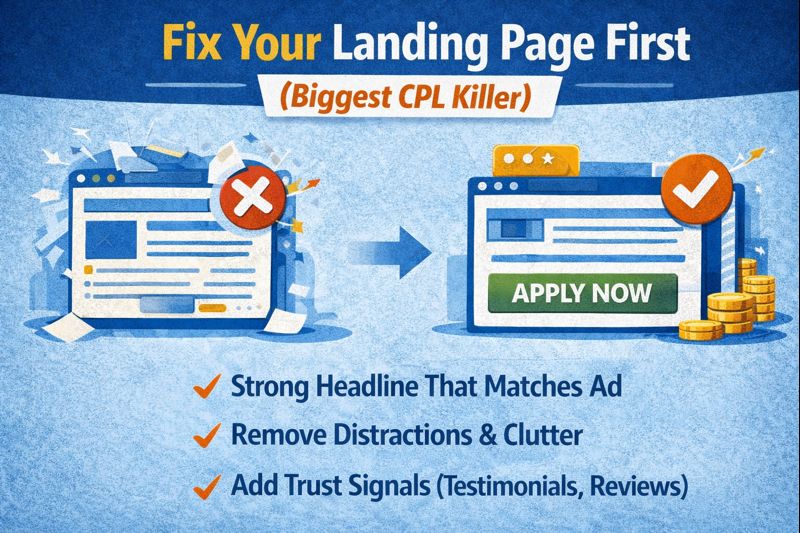
3. Fix Your Landing Page (Biggest CPL Killer)
Most CPL problems are not ad problems — they’re landing page problems.
Why Landing Pages Kill Conversions
- Slow loading
- Poor messaging
- Weak headlines
- Confusing layouts
- Too many distractions
Even 1% increase in conversion rate can drop CPL by 20–30%.
High-Conversion Landing Page Framework (2026)
➜ Headline Must Match Ad Promise
Ad says:
Guaranteed Interview Preparation
Landing headline must repeat:
100% Practical Interview-Focused Training Program
Message mismatch = higher bounce rate.
➜ Remove Distractions
Avoid:
- Menu bars
- Multiple CTAs
- External links
Goal = only lead generation
➜ Add Trust Elements
- Student testimonials
- Trainer experience
- Google reviews
- Batch photos
- Real success stories
Trust reduces friction → more conversions → lower CPL.
4. Use Funnel-Based Advertising (Not Single-Step Ads)
Single-step ads = higher CPL
Multi-step funnel = lower CPL + better quality leads
Example Funnel Strategy:
Stage 1 – Awareness (Video / Reel Ads)
Educate + build trust
Stage 2 – Engagement (Carousel / Blog / Case Studies)
Nurture interest
Stage 3 – Lead Ads (High-intent users only)
Capture warm leads
This reduces CPL by 30–60%.
5. Improve Lead Quality to Reduce Wastage Cost
Low-quality leads increase:
- Follow-up cost
- Sales time
- Conversion friction
Better lead quality indirectly reduces overall acquisition cost.
Smart Lead Filtering Methods
- Add qualifying questions
- Use budget expectation field
- Ask experience level
- Intent-based CTAs
Example:
Want to build career or just exploring?
Filters serious leads.
6. Use Retargeting to Reduce Average CPL
Retargeting leads cost 3–5x less than cold leads.
Best Retargeting Audiences
- Page visitors
- Video viewers
- Lead form openers
- WhatsApp clickers
- Instagram engagers
Even 10–20% budget reallocation to retargeting can significantly drop CPL.
7. Optimise Creatives Weekly, Not Monthly
Ad fatigue increases CPL silently.
Signs of Creative Fatigue:
- Rising CPC
- Falling CTR
- Stable targeting but worse CPL
Solution:
Refresh creatives every 7–10 days.
8. Track Micro Conversions Instead of Only Leads
Micro conversions:
- Scroll depth
- Video watch %
- Button clicks
- Page engagement
These signals help platforms optimize delivery → lower CPL.
Real Example: How CPL Reduced by 52% Without Budget Increase
Scenario:
Digital marketing institute running Meta + Google Ads.
Before optimisation:
- Budget: ₹1,000/day
- Leads: 10
- CPL: ₹100
After funnel + landing page + creative optimization:
- Budget: ₹1,000/day
- Leads: 21
- CPL: ₹47
No budget increase — only system optimisation.
Common Mistakes That Increase CPL
- Broad targeting
- Poor landing experience
- Generic ad copies
- No retargeting
- Weak trust signals
- One-step funnel
Simple CPL Reduction Checklist (2026)
| Area | Action |
|---|---|
| Targeting | Segment & refine |
| Ads | Problem-based messaging |
| Creatives | Weekly refresh |
| Funnel | Multi-step flow |
| Landing | Conversion-focused |
| Retargeting | Mandatory |
| Tracking | Micro-conversion setup |
FAQ
Yes. Landing page optimisation alone can reduce CPL by 30–50%.
Depends on industry. Focus more on lead quality & ROI.
No. Optimise funnel first. Lower budget often reduces algorithm learning.
Depends on search intent.
Google = High intent
Meta = Demand generation
Conclusion
Reducing Cost Per Lead without increasing budget is not about tricks.
It’s about:
System thinking + funnel optimisation + real user understanding.
Brands that master this will:
- Scale profitably
- Beat competitors
- Build sustainable acquisition systems