Introduction: Why Understanding Google Search Matters More in 2026
Every time you search something on Google, it delivers results in seconds. But have you ever wondered how Google actually finds, understands, and ranks billions of web pages so quickly?
In 2026, Google Search has become smarter, faster, and more user-focused than ever before. With AI-powered algorithms, real-time crawling, and intent-based ranking systems, understanding how Google Search works is no longer optional especially for:
- Website owners
- SEO professionals
- Digital marketers
- Students learning digital marketing
- Business owners
In this guide, we will break down Google Search into simple, easy-to-understand steps — crawling, indexing, and ranking using real-world examples and modern SEO insights.
No technical jargon. No confusing explanations. Just clear, practical understanding.
How Google Search Works – The Simple 3-Step Process
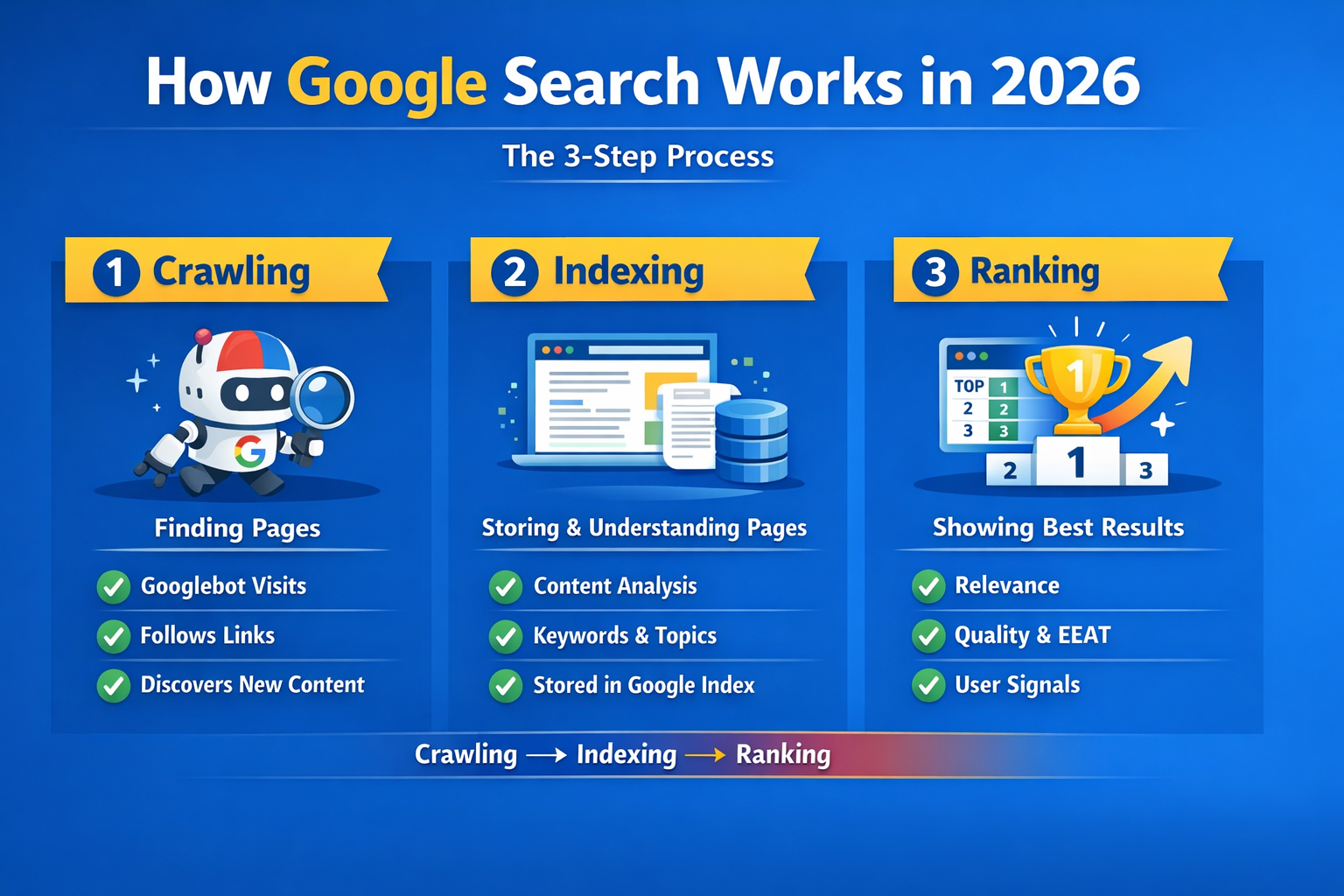
Google Search works in three main stages:
- Crawling – Finding pages
- Indexing – Understanding and storing pages
- Ranking – Showing best results to users
Let’s understand each step in a simple way.
Step 1: Crawling – How Google Finds Web Pages
What is Crawling?
Crawling is the process where Google discovers new and updated web pages using automated programs called Googlebots (or crawlers).
Think of Googlebot as a digital explorer that continuously travels across the internet, moving from one link to another.
How Crawling Works (Simple Example)
Imagine the internet as a huge city and websites as buildings.
Googlebot:
- Starts from known websites
- Clicks on links
- Finds new pages
- Follows internal and external links
- Discovers fresh content
This is exactly how Google finds your website.
How Google Decides Which Pages to Crawl
In 2026, Google uses smart systems to decide:
- Which pages to crawl
- How often to crawl
- How deep to crawl
Google prioritises:
- Frequently updated websites
- Fast-loading websites
- Mobile-friendly pages
- High-authority domains
- Pages with fresh content
Factors That Affect Crawling in 2026
| Factor | Impact |
|---|---|
| Website speed | Faster crawling |
| Mobile-friendliness | Higher crawl priority |
| Internal linking | Better discovery |
| XML sitemap | Faster indexing |
| Server performance | Crawl efficiency |
| Duplicate content | Reduced crawl |
How You Can Improve Crawling
- Submit XML sitemap in Google Search Console
- Use proper internal linking
- Avoid broken links
- Improve website speed
- Keep content fresh
- Fix crawl errors
Step 2: Indexing – How Google Understands Your Content
What is Indexing?
Indexing is the process where Google analyses, understands, and stores your web pages in its massive database (index).
If crawling is finding, indexing is understanding and saving.
If your page is not indexed, it cannot appear in search results, no matter how good your content is.
How Google Understands Content in 2026
Google no longer just reads keywords.
It now understands:
- Meaning
- Context
- Search intent
- Content depth
- Semantic relationships
Thanks to advanced AI models, Google can understand content almost like a human.
What Google Analyses While Indexing
- Text content
- Headings (H1, H2, H3)
- Images & alt text
- Videos
- Page structure
- Internal links
- Schema markup
- User experience signals
Why Some Pages Don’t Get Indexed
- Thin or duplicate content
- Technical SEO issues
- Noindex tags
- Poor site structure
- Low-value pages
- Slow loading speed
How to Improve Indexing
- Write original, valuable content
- Use proper heading structure
- Fix technical SEO errors
- Improve site architecture
- Use schema markup
- Submit URLs in Search Console
Step 3: Ranking – How Google Decides Who Appears First
This is the most important step.
Ranking decides:
- Which page appears first
- Which page gets traffic
- Which business gets leads
What is Ranking?
Ranking is the process where Google evaluates billions of pages and shows the most relevant, helpful, and trustworthy results for a user’s query.
How Ranking Works in 2026
Google uses hundreds of ranking signals, combined with AI-driven systems, to evaluate:
- Relevance
- Quality
- Experience
- Trust
- Authority
- User satisfaction
Major Ranking Factors in 2026
| Factor | Importance |
|---|---|
| Content quality | Very High |
| Search intent match | Very High |
| EEAT (Experience, Expertise, Authority, Trust) | Very High |
| Page speed | High |
| Mobile UX | High |
| Backlink quality | High |
| Content freshness | Medium |
| Engagement metrics | High |
What is EEAT and Why It Matters in 2026?
Google heavily prioritises EEAT:
- Experience – Real-world usage
- Expertise – Subject knowledge
- Authority – Industry recognition
- Trust – Credibility and authenticity
In 2026, experience-based content ranks far better than generic informational articles.
How AI Has Changed Google Search in 2026
AI is no longer an add-on — it is the core of Google Search.
Key AI Improvements:
- Intent understanding
- Semantic search
- Predictive suggestions
- Contextual ranking
- Spam detection
- Helpful content classification
Google now focuses more on:
“Did the user get the best possible answer?”
Not:
“Did the page use the keyword 20 times?”
How Search Intent Controls Rankings in 2026
Understanding user intent is now the foundation of SEO.
Types of Search Intent:
- Informational – Learning something
- Navigational – Finding a website
- Commercial – Comparing options
- Transactional – Ready to buy
If your content does not match search intent, ranking becomes very difficult.
Real Example: How Google Ranks a Blog Post
Search Query: Best Digital Marketing Course in Thane
Google checks:
- Course content quality
- Trainer experience
- Student reviews
- Website authority
- Local relevance
- Trust signals
- Content depth
Only pages offering real value, credibility, and local relevance reach the top.
How Website Owners Can Optimise for Google in 2026
On-Page SEO Best Practices:
- High-quality human-written content
- Clear heading structure
- Proper keyword placement
- Internal linking
- Fast loading pages
- Mobile-friendly design
Technical SEO Essentials:
- Core Web Vitals optimisation
- Crawlability
- Indexation control
- Structured data
- Clean site architecture
Content Strategy for 2026:
- Experience-driven content
- Original insights
- Case studies
- Real-world examples
- Practical tutorials
- Industry data
Common SEO Mistakes That Hurt Ranking
- Overusing keywords
- Thin content
- AI-generated low-quality blogs
- Duplicate pages
- Poor internal linking
- Ignoring technical SEO
- Not updating old content
Future of Google Search: What to Expect Next
In coming years, Google Search will focus even more on:
- AI-generated summaries
- Conversational search
- Voice & visual search
- Hyper-personalized results
- Trust-based ranking
Which means SEO in 2026 is more about quality than tricks.
FAQs – How Google Search Works in 2026
1. How long does Google take to index a new website?
It usually takes from a few hours to a few days, depending on crawl priority and website quality.
2. Does AI-written content rank on Google?
Only if it provides genuine value. Low-quality AI-generated content is increasingly filtered out.
3. What is the most important ranking factor in 2026?
Search intent matching + content quality + EEAT.
4. How often does Google crawl websites?
High-authority websites are crawled multiple times daily, while small sites may be crawled less frequently.
5. Can new websites rank on Google?
Yes, with strong content, technical SEO, and proper optimisation, even new websites can rank.
Conclusion
Understanding how Google Search works in 2026 is not just useful — it is essential.
Whether you are:
- Learning digital marketing
- Managing a business website
- Running SEO campaigns
- Building content strategies
Knowing how crawling, indexing, and ranking truly function helps you build long-term, sustainable traffic instead of chasing algorithm hacks.