Introduction
Digital marketing has always been driven by data. But in the past few years, the way marketers use data has changed dramatically.
Artificial Intelligence (AI) is now helping businesses analyze customer behaviour, predict trends, automate campaigns, and improve marketing performance faster than ever before.
Earlier, marketers had to manually analyze reports, run A/B tests for weeks, and guess what customers wanted. Today, AI tools can process massive amounts of data in seconds and suggest the best marketing actions.
From content creation and ad targeting to customer service and lead generation, AI is quietly reshaping how digital marketing works.
In this blog, we’ll explore how AI is changing digital marketing, what practical benefits it brings, and how businesses can use it to grow faster.
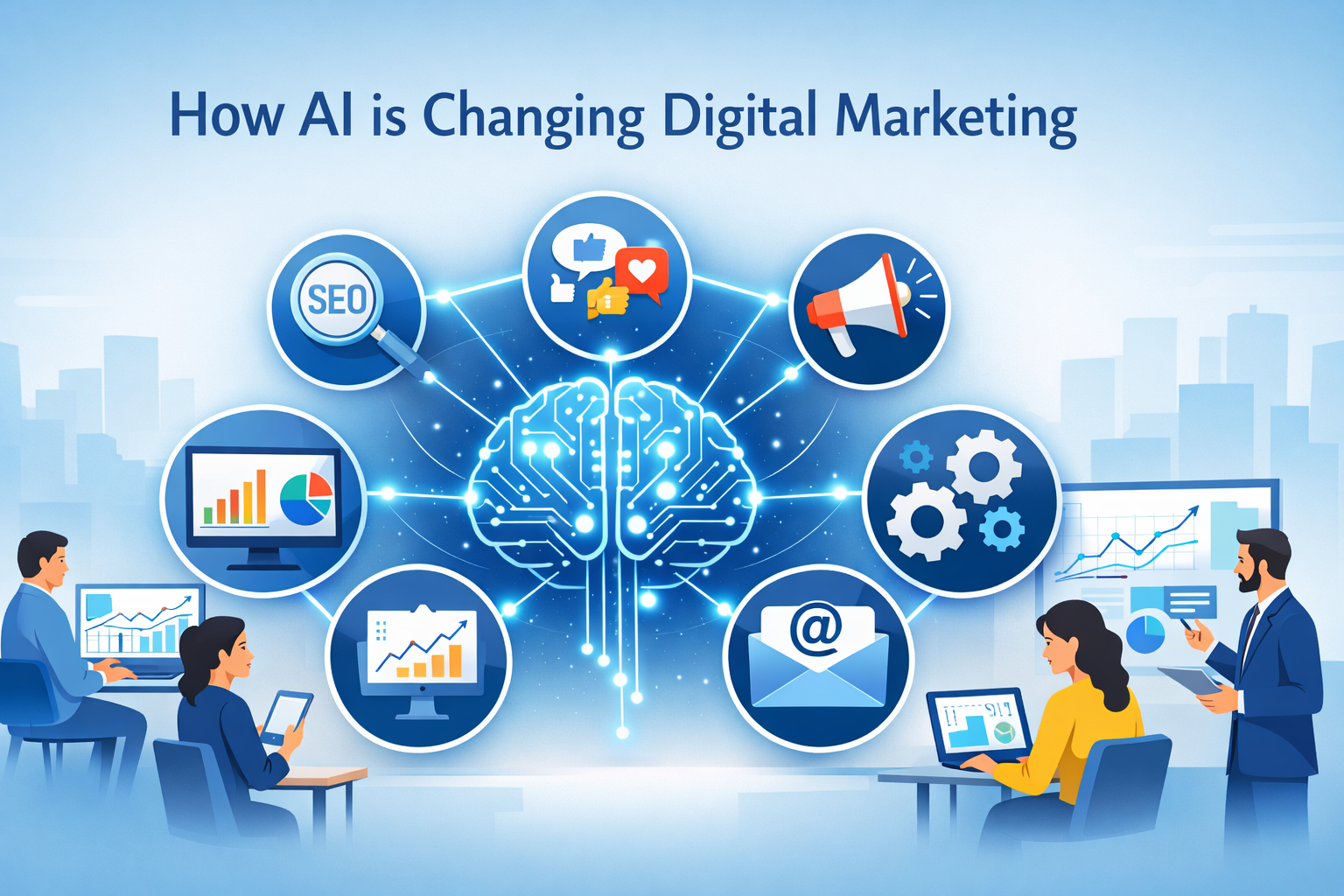
How AI is Changing Digital Marketing
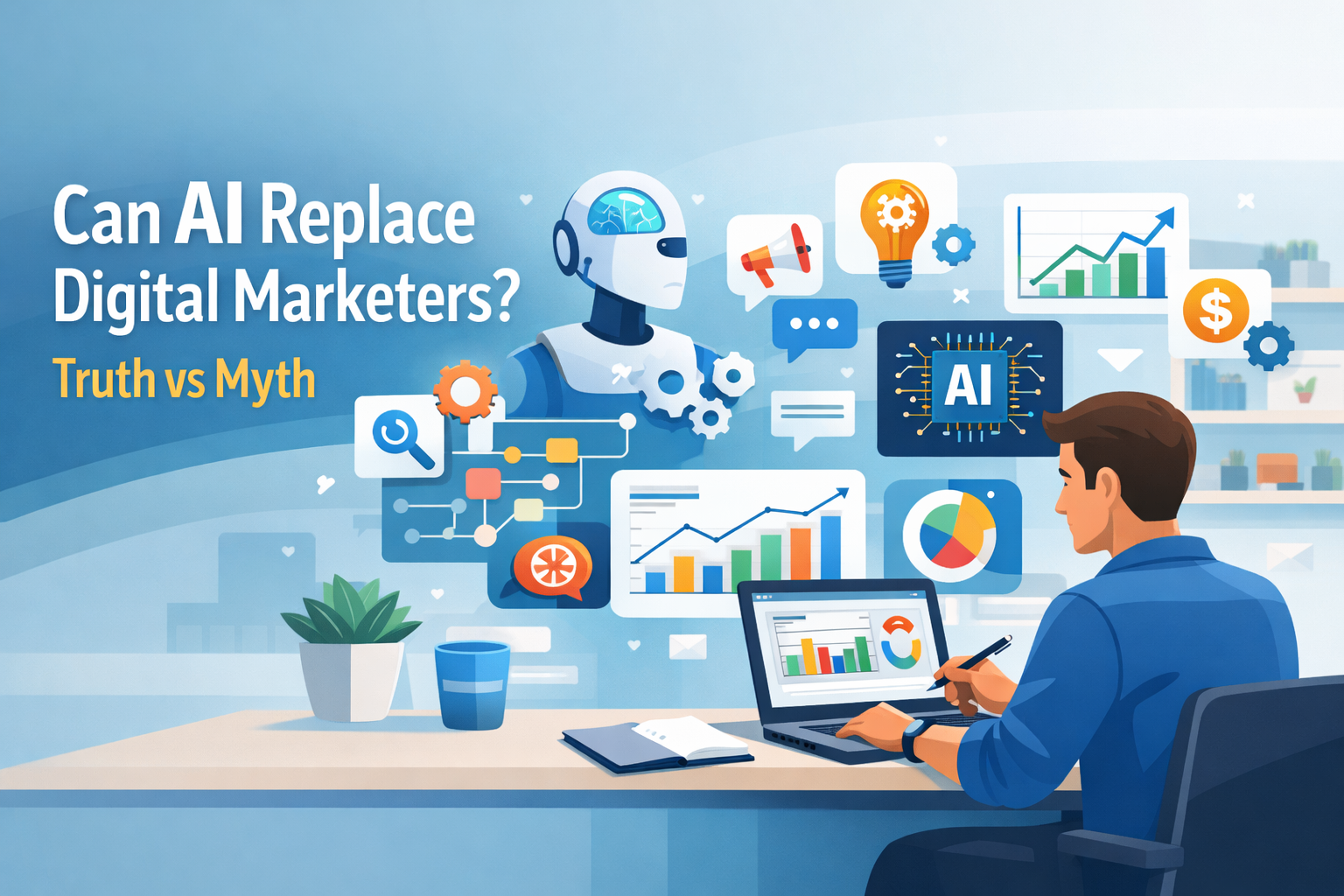
AI is not replacing marketers. Instead, it is helping marketers make better decisions, faster.
Let’s look at the most important areas where AI is making a real impact.
1. Smarter Customer Insights and Data Analysis
One of the biggest advantages of AI is its ability to analyze large datasets quickly.
Marketers collect data from many sources:
Website analytics
Social media engagement
Email campaigns
CRM systems
Ad platforms
Earlier, understanding this data required hours of manual analysis.
AI tools can now:
Identify customer behavior patterns
Predict buying intent
Segment audiences automatically
Recommend marketing actions
Example
An eCommerce store may discover through AI analysis that:
Customers who view 3 product pages are more likely to convert
Visitors from Instagram ads spend more time on the site
Mobile users abandon carts more frequently
Using this data, marketers can improve targeting and increase conversions.
Traditional Marketing vs AI-Powered Marketing
| Factor | Traditional Marketing | AI-Powered Marketing |
|---|---|---|
| Data analysis | Manual reports | Automated insights |
| Targeting | Broad audiences | Precise audience segments |
| Campaign optimisation | Slow testing | Real-time optimisation |
| Personalisation | Limited | Highly personalised |
| Decision making | Guess-based | Data-driven |
AI allows marketers to make decisions based on patterns instead of assumptions.
2. AI-Powered Personalisation
Modern consumers expect personalised experiences.
AI helps businesses deliver relevant content, product recommendations, and offers to each user.
Platforms like eCommerce websites, streaming services, and online marketplaces already rely heavily on AI-driven personalisation.
How AI Personalisation Works
AI analyzes:
Browsing history
Purchase behaviour
Time spent on pages
Device and location
Engagement patterns
Based on this data, marketing platforms can automatically show:
Personalized emails
Product recommendations
Dynamic website content
Targeted ads
Real-world Example
If a user searches for running shoes, AI systems may show:
Sportswear ads on Instagram
Fitness content on YouTube
Discount emails from sports brands
This level of personalisation increases:
Click-through rates
Engagement
Conversions
3. AI in Content Creation and Marketing
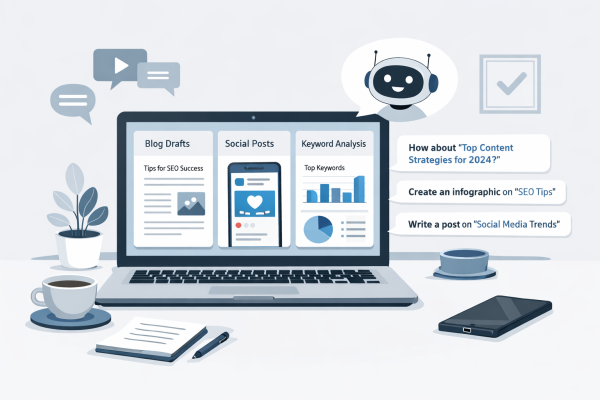
Content marketing is one of the biggest areas where AI is helping marketers.
AI tools assist with:
Blog writing
Ad copy generation
Email subject lines
Social media captions
Video scripts
Content ideas
However, the real value comes when AI supports human creativity, not replaces it.
Where AI Helps Most
AI can quickly generate:
Topic ideas
Keyword suggestions
Content outlines
Draft content
Marketers then refine the content with:
Experience
Brand voice
Industry insights
This combination speeds up content production while maintaining quality.
4. AI Improves Advertising Performance
Running digital ads involves many decisions:
Audience targeting
Budget allocation
Bid adjustments
Creative testing
AI helps optimise these elements automatically.
Ad platforms like Google Ads and Meta Ads already use machine learning to improve campaign results.
AI in Advertising Helps With:
Smart bidding strategies
Predicting conversion probability
Audience expansion
Ad creative optimisation
Budget allocation
Example Scenario
Suppose a company runs ads for an online course.
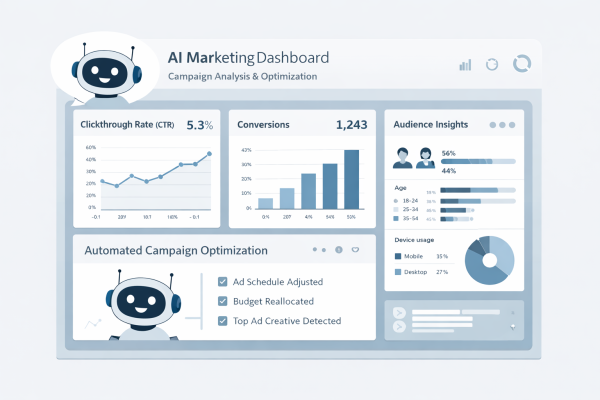
AI systems can automatically identify:
Which audience converts the most
Which ad creative gets higher CTR
Which time of day produces the best results
The system then adjusts campaigns in real time.
This leads to:
Lower cost per lead
Better ad performance
Higher ROI
5. AI Chatbots and Customer Support
Customer communication is another area where AI is changing marketing.
AI chatbots can now handle:
Customer inquiries
Product recommendations
Order tracking
Lead qualification
Appointment booking
Unlike human teams, chatbots can work 24/7.
Benefits of AI Chatbots
Faster response times
Reduced support costs
Better customer experience
Higher lead capture rates
Example
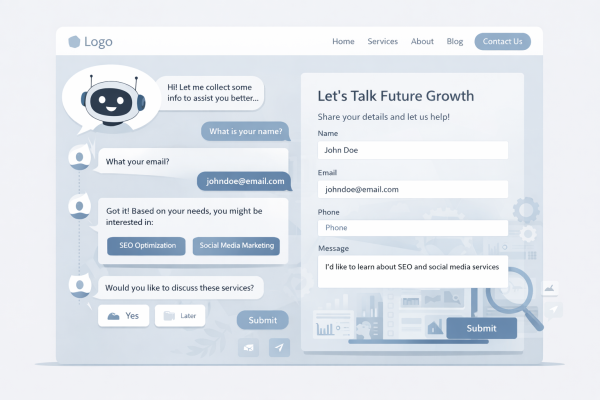
A digital marketing agency website may use an AI chatbot to:
Answer course-related questions
Collect student enquiries
Schedule consultation calls
This ensures that potential leads are captured even outside business hours.
6. AI in SEO and Search Optimization
Search engine optimisation is also evolving because of AI.
Search engines themselves now use AI to understand content better.
This means SEO strategies must focus more on:
Helpful content
Topic authority
User intent
Experience-based writing
AI tools help SEO professionals with:
Keyword research
Content optimization
Competitor analysis
Search intent analysis
SERP tracking
However, human expertise is still essential.
Google prioritizes content that demonstrates:
Experience
Expertise
Authority
Trust
So AI should assist content creation — not replace thoughtful writing.
7. AI for Lead Generation and Marketing Automation
Lead generation is one of the most powerful uses of AI in marketing.
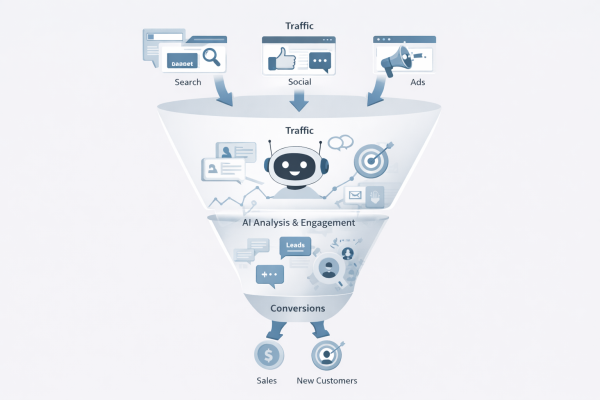
AI can automatically identify high-quality leads and guide them through the marketing funnel.
AI Helps Automate
Email sequences
Lead scoring
CRM segmentation
Follow-up campaigns
Retargeting strategies
Example Funnel Using AI
| Stage | AI Role |
|---|---|
| Awareness | Targeted ads |
| Interest | Personalized landing pages |
| Consideration | Automated email sequences |
| Decision | AI chat assistance |
| Conversion | Smart retargeting |
This reduces manual work while improving conversion rates.
Challenges & Future of AI in Digital Marketing
Challenges of AI in Digital Marketing
While AI offers many benefits, businesses must also understand its limitations.
Common Challenges
1. Overdependence on automation
Too much automation can reduce creativity.
2. Data privacy concerns
AI systems rely heavily on user data.
3. Lack of strategy
AI tools cannot replace strategic thinking.
4. Poor content quality
If AI-generated content is used without editing, it can harm SEO performance.
The best approach is AI-assisted marketing guided by human expertise.
The Future of AI in Digital Marketing
AI adoption is growing rapidly.
In the coming years, we can expect:
More predictive marketing tools
AI-powered creative generation
Automated customer journeys
Smarter marketing analytics
Voice and visual search optimisation
Businesses that start using AI early will gain a major competitive advantage.
However, success will still depend on:
Strategy
Creativity
Customer understanding
AI is simply a powerful tool that helps marketers execute faster.
FAQs
AI in digital marketing refers to the use of artificial intelligence technologies to analyse data, automate marketing processes, personalise campaigns, and improve marketing performance.
AI improves marketing campaigns by analysing customer behaviour, predicting trends, optimising ad targeting, and automating campaign decisions in real time.
No. AI assists marketers but does not replace them. Human creativity, strategy, and decision-making remain essential in successful marketing.
Some commonly used AI marketing tools include:
ChatGPT for content creation
Jasper for copywriting
Surfer SEO for content optimisation
HubSpot AI tools for CRM automation
Google AI-powered ad optimisation
Yes. Understanding AI tools and marketing automation will become an essential skill for future digital marketing professionals.
Conclusion
Artificial Intelligence is transforming the way businesses approach AI in digital marketing. From smarter data analysis and personalized marketing to automated advertising and AI-powered chatbots, marketers can now make faster and more informed decisions. The role of AI in digital marketing is helping businesses understand customer behaviour, optimise campaigns, and improve overall marketing performance.
As technology continues to evolve, the future of AI in digital marketing will bring even more advanced tools, automation, and predictive insights. Businesses and professionals who learn how to use AI tools for digital marketing effectively will gain a strong competitive advantage. Understanding how AI is changing digital marketing is no longer optional—it is becoming an essential skill for anyone who wants to succeed in the modern marketing industry.